
Controller for 8 electroluminescent wires
SKU 6168-ELSEQUEEAN 8219671076104Item type: AssembledMood lighting & gadgets
Description
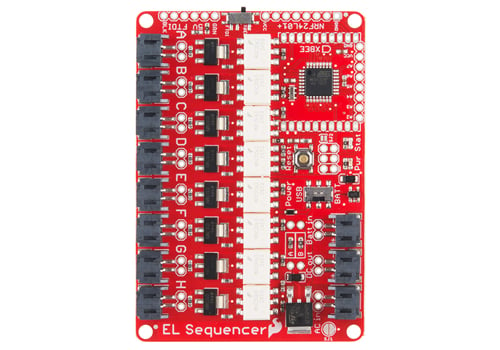
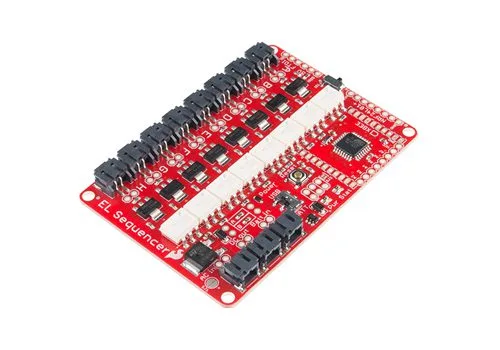
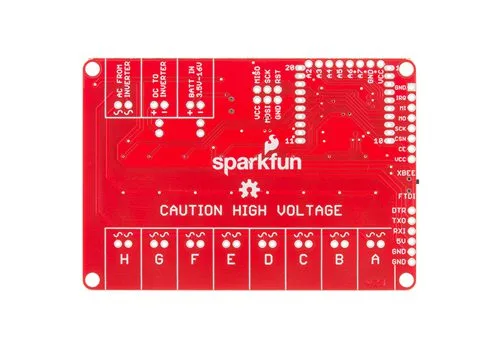
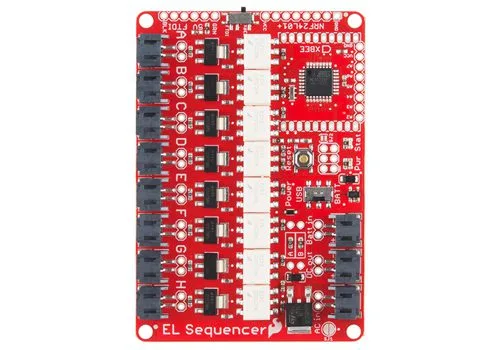
Based on the ATmega328P microcontroller (the same microcontroller used in Arduino UNO), this controller allows you to manage up to 8 electroluminescent wires. It can be programmed via the Arduino IDE using a 5V USB-Serial FTDI converter (not included), and create your own sequence of effects. It has eight opto-isolated outputs, pads for mounting Xbee modules, for the NRF24L01 Wireless module, and for the FTDI converter needed for programming. The controller can be powered at 3.7 V with a Lipo battery (it is necessary to use a 3V inverter), or with external power from 3.3 V to 16 V (using a 3 V or 12 V inverter). Dimensions (mm): 82.50×57.75×7.2.
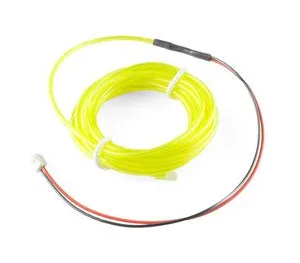
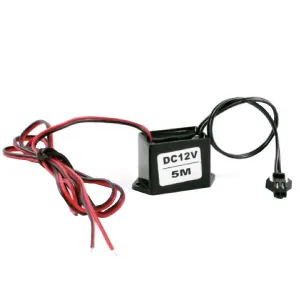
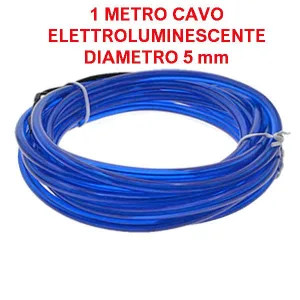
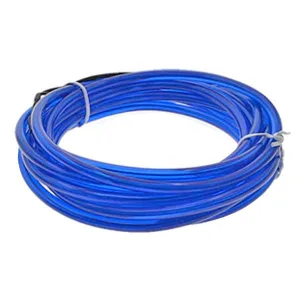
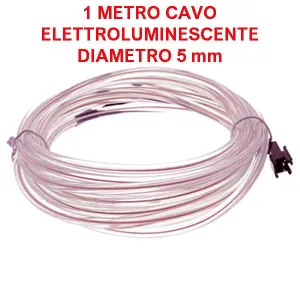
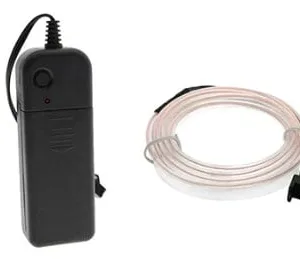
N.B. the inverter, Lipo battery, Xbee modules, NRF24L01 Wireless module, and electroluminescent wires are not included (see related products).
Warning! When the controller is powered, high voltage is present on the PCB, be extremely careful! Do not touch the board when powered.
Technical specifications
- ATmega 328P chip with Arduino bootloader
- Eight opto-isolated outputs
- Pads for mounting Xbee modules, NRF24L01 Wireless module, and for programming via 5V USB-Serial FTDI converter (not included)
- No library needed, and control is as easy as turning an LED on and off
- Has a 1.5 A linear voltage regulator (LM317) set to 3.3V, but can be changed via the PTH resistor or by bypassing it entirely
- Can be powered at 3.7 V with Lipo battery (using 3 V inverter), or with external power from 3.3 V to 16 V (using 3 V or 12 V inverter)
Documentation and useful links
You may also like…
-
 Mood lighting & gadgets
Related products
-
 Mood lighting & gadgets
 -
 Games
Games -
 Mood lighting & gadgets
 -
 Mood lighting & gadgets
 -
 Mood lighting & gadgets
 -
 Mood lighting & gadgets
 -
 Educational kits
 -
 Mood lighting & gadgets