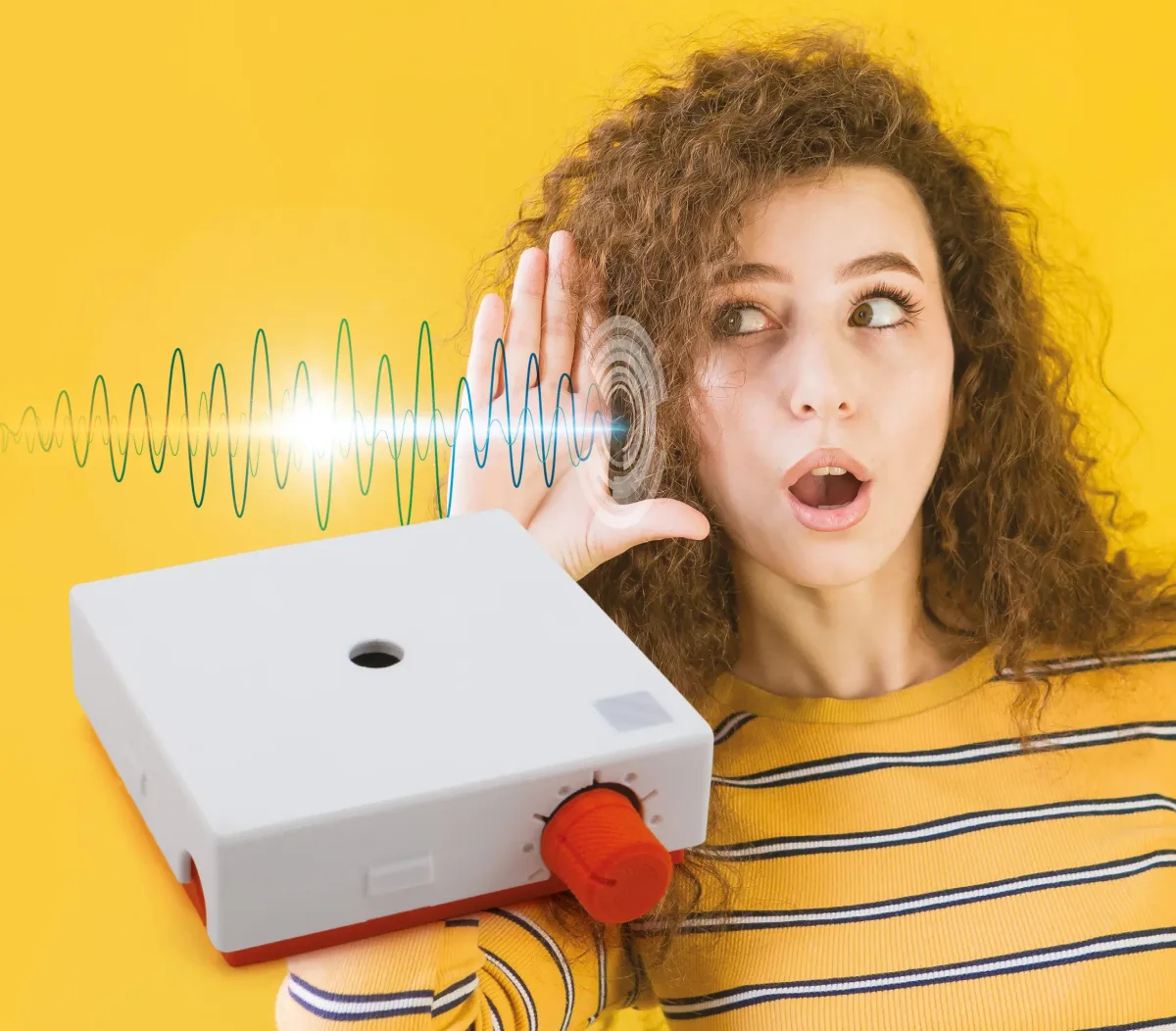
Angelo: an open source portable audio amplifier optimized for the human voice
We build a portable, open source audio amplifier optimized for the human voice, designed to improve communication with elderly or hearing-impaired people, and easy to use and customize.
Some projects are born from a simple technical idea, while others come to life from the real need to solve a concrete human problem.
The Angelo project strongly belongs to this second category. It is 2020, in the middle of the COVID-19 pandemic. The images of isolated nursing homes, of elderly people separated from their families, are still vivid in the collective memory.
Luciano Fumagalli, a maker and electronics enthusiast, personally experiences the difficulty of communicating with his father-in-law Angelo, over a hundred years old and profoundly hearing-impaired, isolated in a care facility. Social distancing, masks, and the lack of adequate technologies turn every visit into a frustrating moment, marked by the impossibility of understanding each other and by the fear that silence might be perceived as abandonment.
Thus, almost out of necessity, the first version of the device we now know as “Angelo” is born. The idea takes shape during one of these meetings, when Luciano, observing his wife’s struggle to communicate, realizes that it is necessary to go beyond the simple “volume” amplification of the voice. What is needed is a system that brings back the human meaning of communication, enhancing the speech frequencies that most help language comprehension.
A highly relevant insight, considering that according to the World Health Organization, by 2050 there will be 2.5 billion people worldwide living with hearing loss (Fig. 1).

Fig. 1 By 2050, 2.5 billion people will have hearing problems.
An alarming figure that underscores the urgency of finding accessible, effective, and inclusive solutions.
After initial experiments with kits designed for listening to nature, and encouraged by the positive impact on Angelo’s quality of life, Luciano decides to share the solution, embracing the open source philosophy.
Not a closed solution, but a project accessible to everyone, improvable and replicable, capable of restoring voice and dignity to those who are too often isolated from the world due to a simple hearing loss.
From the very beginning, the Angelo project was designed to be easily accessible and replicable.
The spirit of sharing concerns not only the software, but also the hardware, assembly instructions, and educational guides. Everyone can contribute with suggestions, modifications, and new features.
This openness, which reflects the mission of maker communities, has allowed Angelo to become a true solidarity movement.
Schematic
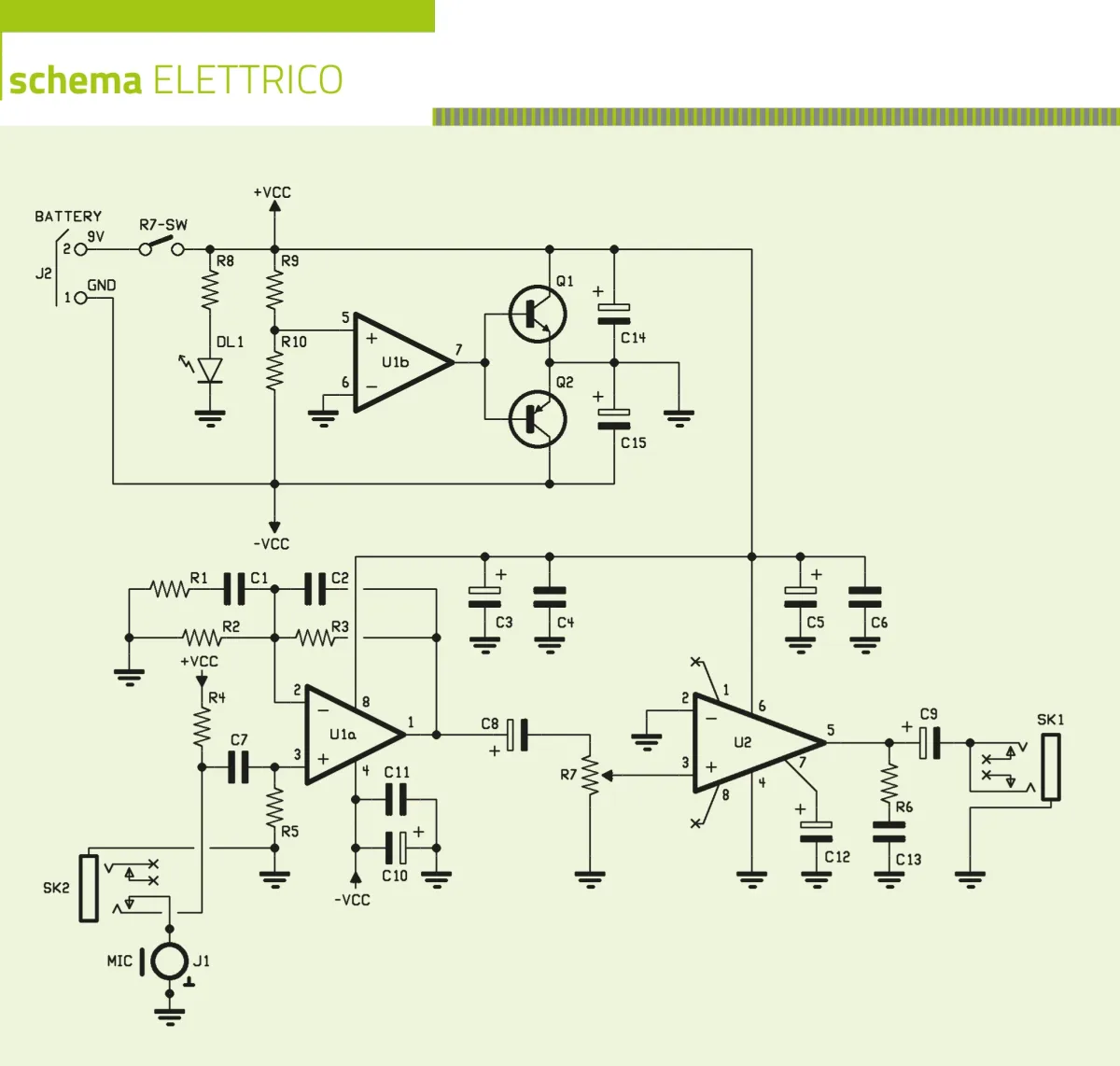
The Angelo schematic has been designed with two fundamental goals: maximum ease of use and high audio quality, especially regarding human voice comprehension. Every component choice, circuit topology, and element arrangement stems from this dual requirement.
Dual power supply: an elegant solution with a single battery
One of the most refined and less obvious aspects of Angelo is the management of the dual power supply. We know that many operational amplifiers, especially in quality audio applications, require a “symmetrical” supply voltage, that is, one that provides both a positive (+VCC) and a negative (–VCC) rail relative to a central ground point (GND).
This allows handling alternating signals, such as audio, without introducing distortion due to excursion limits or “clipping” towards the negative rail. But how do you get a dual supply from a simple 9V battery? In the Angelo circuit, the solution is entrusted to a specific section, formed by the second half of the TL072 (U1.2), two transistors (Q1 S9013 NPN and Q2 S9012 PNP), two 100µF electrolytic capacitors (C14 and C15), and a resistor network.
The principle is that of the “virtual midpoint”: we take exactly half of the battery voltage through a divider (R9 and R10, both 10kΩ) and feed it to a buffer made with op-amp U1.2.
The buffer, thanks to the two transistors and filter capacitors, provides enough current to all sections of the circuit that need a stable virtual ground, maintaining bias even in the presence of varying audio signals. The result is that, relative to this central point (virtual GND), we have +4.5V and –4.5V, recreating a true dual supply starting from a single battery.
This feature is essential to ensure high audio quality and distortion-free operation, especially in the preamplification of signals from the microphone. An indicator LED (DL1), powered through a current-limiting resistor (R8, 1kΩ), tells the user that the device is on and working.
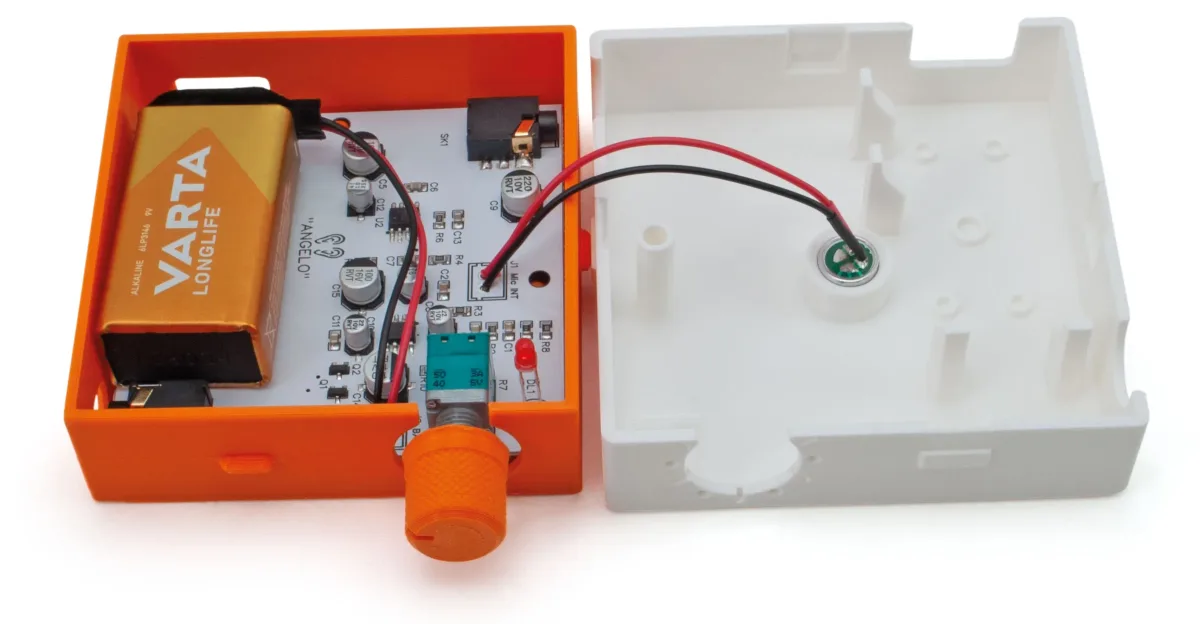
The prototype with the non-rechargeable battery.
Input section: microphone capsule and band-pass filter
Angelo can receive the acoustic signal from either an internal microphone capsule (MIC INT, J1) or an external microphone (SK2). The latter allows the use of microphones with different connection standards, including stereo, professional, or Bluetooth types.
The signal picked up by the microphone is biased and filtered thanks to the network R4 (10kΩ), R5 (50kΩ), and C7 (4.7nF). The capacitor removes any DC components, while resistor R4 provides the necessary bias for electret capsules.
The real “intelligence” of the circuit, however, lies in the network that follows: R1 (470Ω), C1 (330nF), R2 (2.2kΩ), R3 (10kΩ), and C2 (10nF) together with the input of the TL072 op-amp (U1.1) form an active band-pass filter.
This design choice is fundamental: the human voice is concentrated mainly in the range between 300Hz and 3kHz, while many of the critical consonants for speech intelligibility are between 1kHz and 4kHz.
The filter attenuates frequencies that are too low (ambient noise, mains hum, traffic) and those that are too high (rustles, hisses), enhancing the useful band and making it easier to understand words even for those with selective hearing loss.
Capacitors C3 (22µF), C4 (0.1µF), C10 (22µF), and C11 (0.1µF) are included for bypass and voltage stabilization, and to eliminate residual ripple and disturbances that could affect audio signal quality.
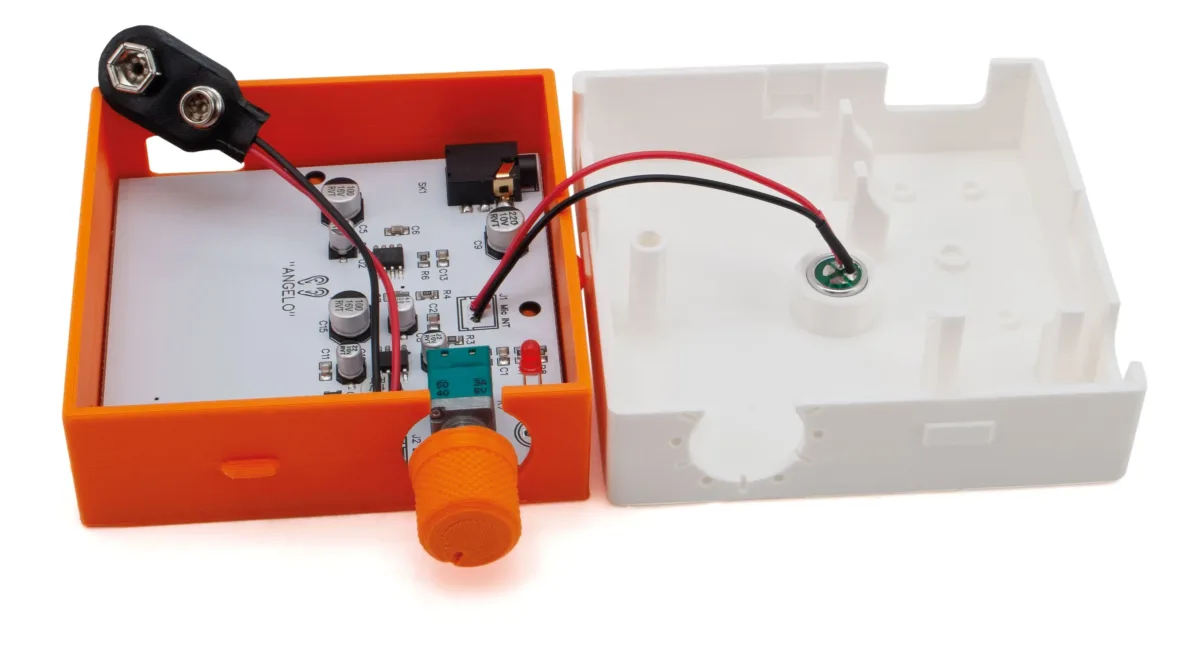
The 3D-printed case can be customized.
Preamplification and volume control
The suitably filtered signal is sent to the non-inverting input of the first half of the TL072 (U1.1).
This op-amp is configured as a non-inverting amplifier, with a gain determined by the ratio between the feedback and input resistors. The signal is thus brought to a level sufficient to be handled by the final amplification stage.
Downstream of the preamplifier is potentiometer R7 (50kΩ), which performs a dual function: it adjusts the listening volume and, thanks to its built-in switch, acts as the device’s main power switch. Turning the potentiometer to minimum automatically disconnects the power, shutting down the entire circuit and extending battery life.
This simple but effective solution avoids the need for a separate switch and makes Angelo even more immediate to use, especially for elderly people or those with reduced manual dexterity.
Final amplification: LM386, low-pass filter, and headphone output
The amplified and regulated signal is sent to the LM386 IC (U2), one of the most famous audio amplifiers for portable applications. In the Angelo circuit, the LM386 is configured with a gain of 20 (default setting without a capacitor between pins 1 and 8), enough to drive a pair of headphones or small speakers.
The network made up of R6 and C13 implements a low-pass filter at about 15kHz, which eliminates high-frequency disturbances, protects the user’s hearing, and ensures faithful voice reproduction without excessive sibilance.
Capacitors C5 (100µF) and C6 (0.1µF) are used to stabilize the LM386’s supply voltage, reducing any fluctuations and disturbances coming from the battery and ensuring quiet, interference-free operation of the audio amplifier. The LM386 output is connected directly to jack SK1, compatible with standard low- or medium-impedance headphones.
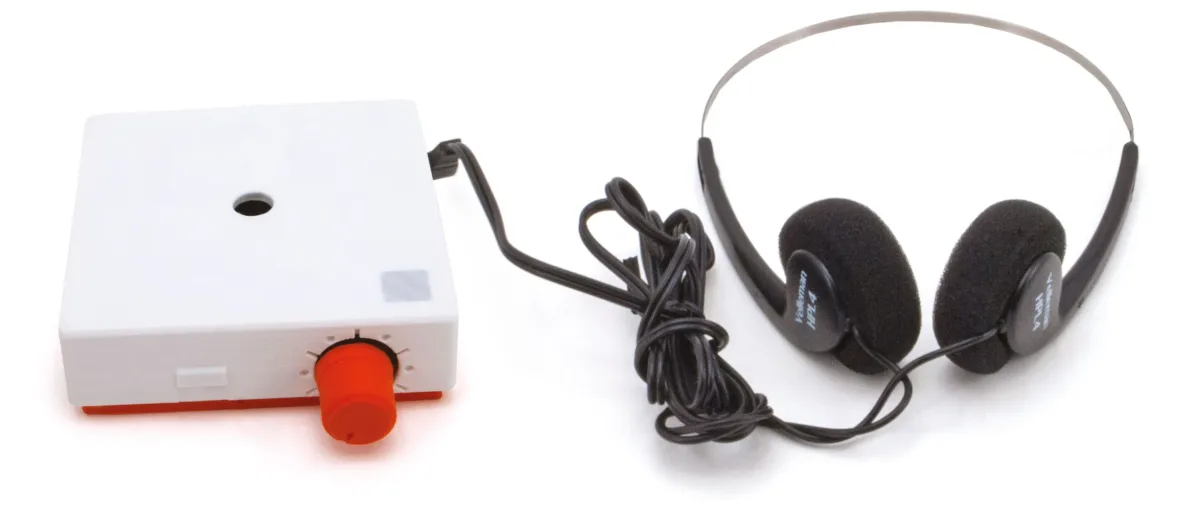
Angelo with simple headphones.
Practical construction
A great advantage of Angelo, compared to many other similar devices, is its complete “plug & play” compatibility. Those who purchase the device will not need to perform any assembly, configuration, soldering, or setup.
All you need is a standard 9V battery, which goes into the dedicated compartment. The LED indicator lights up to confirm everything is working, and by adjusting the potentiometer you can set the volume to suit your needs.
The case is designed for maximum ease of handling: it has no sharp edges and fits comfortably even in unsteady hands. The headphone jack and the potentiometer are well spaced and easy to reach. The open-source design and public documentation let anyone customise the device.
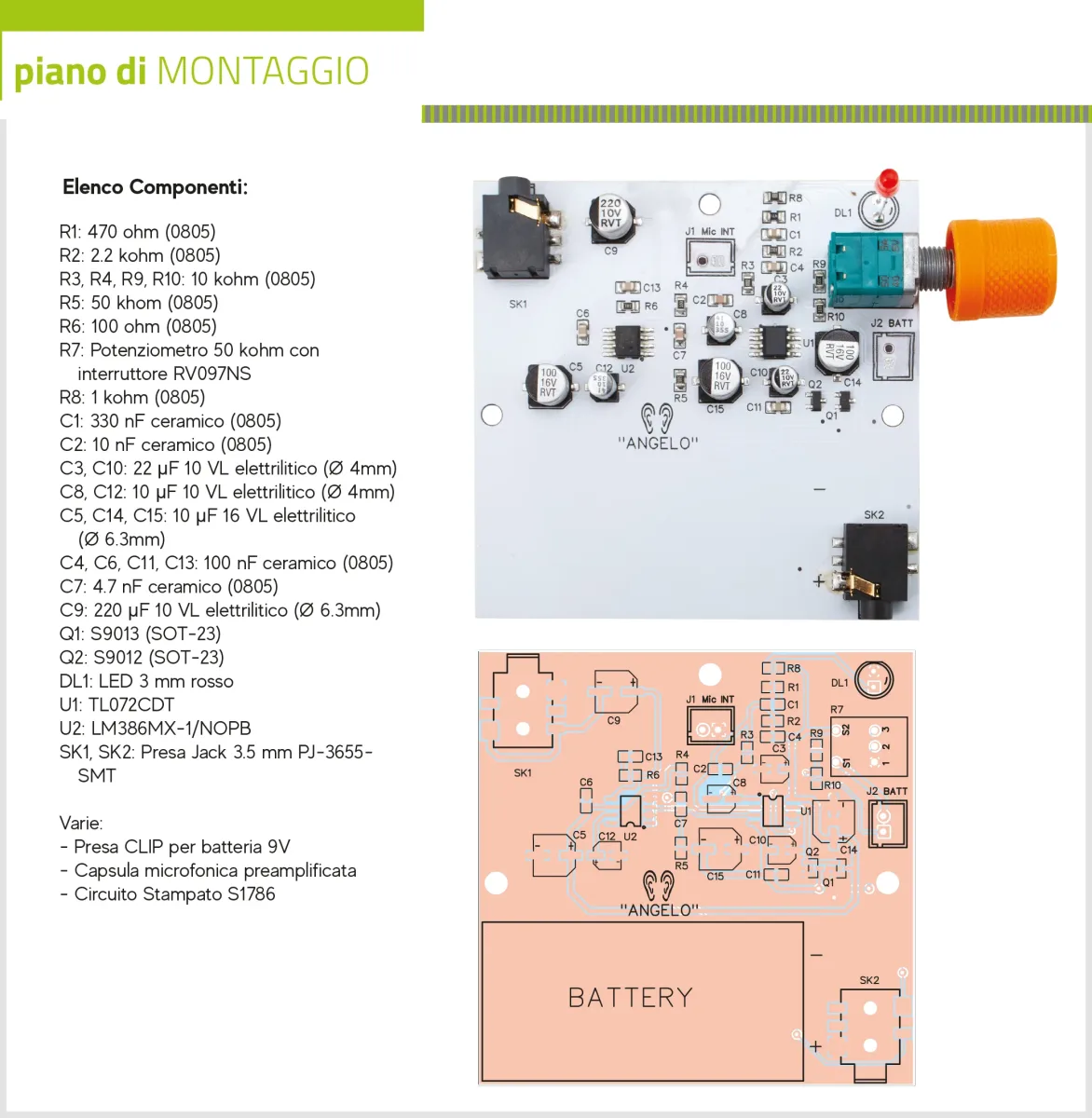
Each user can replace the microphone capsule with a different type or quality, change the frequency response by altering the capacitor and resistor values in the input network, add a wireless microphone through the SK2 input, or customise the case, for example with 3D printing, to suit specific needs such as mounting on a wheelchair or attaching it to different supports.
All these customisations are made easier by the clarity of the schematic and the quality of the SMD assembly, which ensures reliability and durability even in everyday, non-professional use. From a maintenance standpoint, the device only requires periodic battery replacement. All other components are rated to last for years without any intervention.
Conclusion
Angelo is a project that combines engineering, attention to people’s real needs, and a passion for quality and inclusion. Every detail of the circuit has been optimised to make communication accessible even to those who, due to age or illness, temporarily find themselves “out of the world”.
The ability to use the device immediately without any configuration, the care in component selection, and the design transparency make Angelo a solution that anyone can understand, modify, and adapt. Angelo represents a perfect synthesis of science and heart. A small box that amplifies the voice, the emotions, and the possibility of staying close.