
Recessed Circular Spotlight with 12 Watt Warm White LED
SKU 8220-LEDA32WWEAN 8219671065191Item type: AssembledLight bulbs
Description
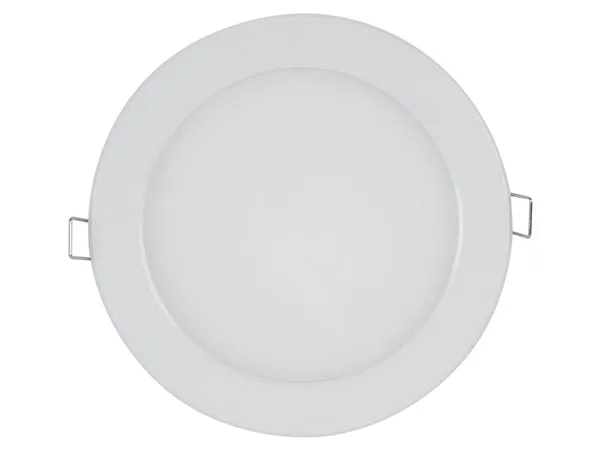
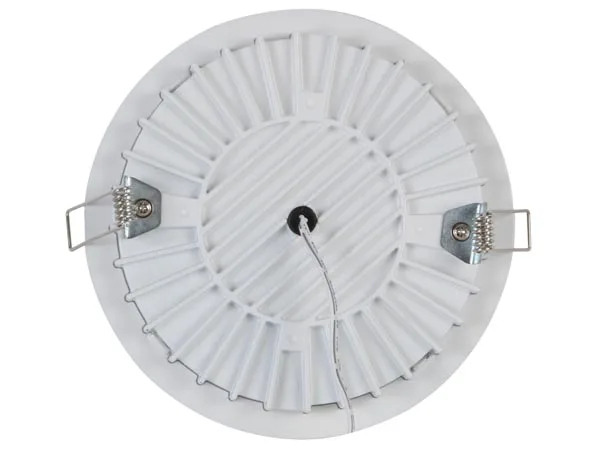
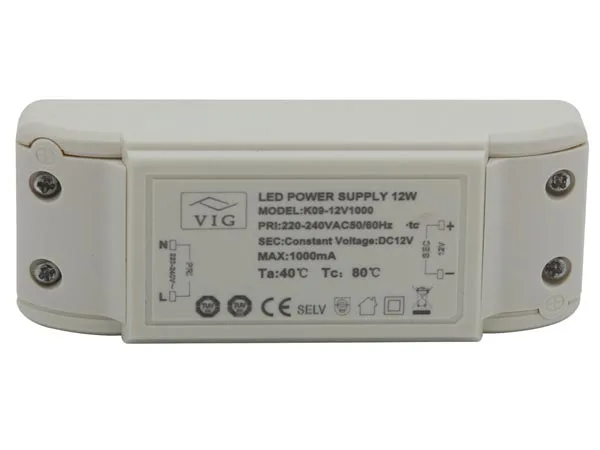
Circular recessed spotlight consisting of 1 warm white LED, aluminum frame, and 2 mm satin acrylic diffuser. It is powered at low voltage via a constant current driver (included), which ensures safety, energy savings, and long life. Instant start, no flicker, no hum. Excellent heat management ensures long-term LED stability. Recessed mounting. Particularly suitable for hotels, offices, hospitals, schools, etc.
Technical specifications
Candela, lumens, and lux: what to look at?
When we want to compare the characteristics of two lamps, we are often at a loss because we do not know how to compare the data provided: some indicate candela, others lumens. Let’s try to clarify. All light sources, and therefore also light bulbs, are characterized by a luminous intensity (I), expressed in candela (cd) or millicandela (mcd, equal to one thousandth of a candela); in the International System of Units, the candela is the intensity of a source of infinitesimal size that does not absorb the light it generates (black body) having a surface of 1/6 x 10-5 m² and placed at the solidification temperature of platinum, measured in a direction perpendicular to the surface itself and in an environment at a pressure of 101,325 pascals. When we talk about candela, we therefore mean luminous intensity, which is the light emitted by the lamp itself. Another parameter that indicates how much light a source generates is luminous flux (Φ), expressed in lumens (lm). These two quantities are related by the fact that luminous flux is the density reached by luminous intensity in a solid angle; precisely, one lumen is the luminous flux produced by a source with an intensity of one candela in a solid angle of 1 steradian. The steradian is the solid angle of 360/6.28° (ratio between the circumference and the radius of a circle) in all directions, i.e., 57.32 degrees. Thus, luminous flux (lumens) is given by the product: Φ = I x α where α is the light emission or irradiation angle, expressed in steradians, which is assumed to be equal in all directions (it is assumed that the lamp emits a cone of light). Therefore, to compare two bulbs knowing the candela of one and the lumens of the other, the light emission angle must be known. Once this is known in sexagesimal degrees, α in steradians is obtained by dividing it by 57.32; for example, a lamp with an emission angle of 45° has an angle of 0.785 steradians. Let’s compare, for example, a lamp of 10,000 mcd that emits over an angle of 45 degrees and one of which we know has a luminous flux of 10 lumens; since 45° is equal to 0.785 steradians, the first determines a luminous flux of: Φ = 10 cd x 0.785 sr = 7.85 lm.
Therefore, the first is less valid than the second. With the same formulas, the quantities not indicated by manufacturers can be derived; for example, if we know that a bulb generates 8 lumens and emits over an angle of 60° (1.047 steradians), we can derive the luminous intensity (I) in candela: I = Φ /α = 8/1.047 = 7.64 cd.
Now let’s compare a bulb with an intensity of 12 candela and another with a luminous flux of 11 lumens and an emission angle of 60° (1.047 sr); we determine the intensity in candela of the second bulb: I = Φ /α = 11/1.047 = 10.5 cd. This time the second bulb is less performant than the first. For LEDs, manufacturers define the luminous intensity and the irradiation or aperture angle, expressed in sexagesimal degrees. Since the lens of the diodes normally determines a conical light emission, it is easy to derive the luminous flux. For example, an LED that emits 2,000 mcd over an angle of 50° (0.872 sr) has a luminous flux of 1.744 lumens.
The various sources of artificial lighting
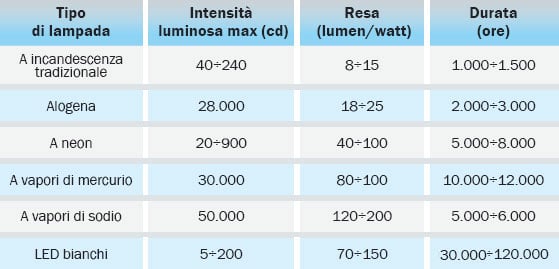
For white LEDs, the life refers to the diodes alone; it becomes lower for LED lamps, because the average life of the control circuit must be taken into account. As for efficiency, it is that typical of the lamp or LED alone: losses in the power supply circuits, which affect neon lamps, vapor lamps, and LEDs, are not considered.
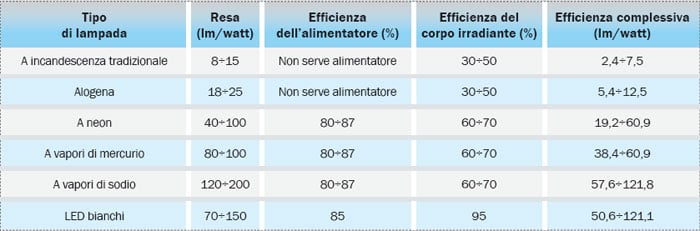
The table below illustrates the efficiency of individual bulbs and the real one, derived by considering the power loss in the devices needed to turn them on. As can be seen, the highest actual efficiency is achieved by LEDs and low-pressure sodium vapor lamps. For correct interpretation of the data, consider that: the source efficiency (lm/W) is the efficiency of the lamp itself – the efficiency of the electrical source (%) defines the losses in the power supply – the efficiency of the radiating body (%) considers the losses of the optical system used to direct the light beam, a system that yields between 30 and 50% in common bulbs (which radiate in almost all directions) versus 95% for LEDs, which have a highly directional light beam already at the emission point – the total efficiency (lm/W) is obtained by multiplying the efficiency by the efficiency of the electrical source by the efficiency of the radiating body. One can get an idea of the meaning of the numbers in the table by trying to calculate the electrical power consumed to obtain a certain luminous flux value, for example 1,000 lumens: using a filament lamp, at least 133 watts are needed, which become 80 W for halogen; with neon and mercury vapor lamps, the required power drops to about 16.6 W and decreases to a minimum of 8.26 W with low-pressure sodium vapor lamps. About 8.3 W is the minimum power required using LED systems. Compared to a classic lamp, the energy saving is about 93%. That is why a decidedly …bright future is foreseen for LED lighting systems!
Technical details
| Power supply | 12 Vdc (via included power adapter) |
|---|---|
| Luminous flux | 780 lumens |
| Color temperature (K) | 2950 |
| Power consumption | 12 W |
| Number of LEDs | 1 warm white type 3528 |
| Beam angle | 120° |
| Diffuser | 2 mm satin acrylic |
| Material | aluminum |
| Dimensions | Ø 148 x 18 mm - recessed hole diameter 134 mm |
| Average life (h) | 40,000 |
| Weight | 270 g |
Related products
-
 Light bulbs
 -
 Light bulbs
 -
 Light bulbs
 -
 Light bulbs
 -
 Light bulbs
 -
 Light bulbs
 -
 Light bulbs
 -
 Light bulbs