
ADC Module – assembled
SKU 7100-BREAKOUT012EAN 8219671070768Item type: AssembledADC / DAC
Description
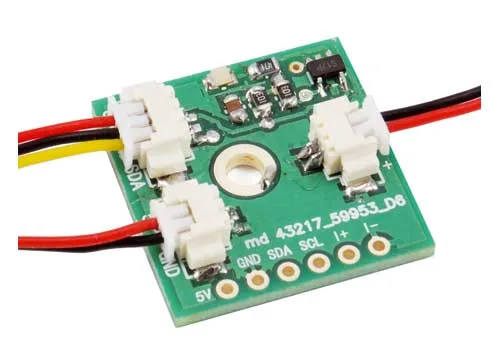
Breakout board based on the MCP3221 analog-to-digital converter IC (SMD type SOT-23-5) from Microchip. The IC allows A/D conversion with a resolution of 12 bits (4096 steps) depending on the supply voltage. The mounted chip is the MCP3221A5T model, which has a factory-set I2C address (for all details, see the component datasheet). If the device is powered at 5 V, the input dynamic range extension is 5,000 mV, so the definition, understood as the voltage value corresponding to the smallest sampled portion (one bit of the 4,096 possible) is obtained from the ratio 5,000/4,096, i.e., Vdd/4.096. The maximum input voltage for conversion is also a function of the supply voltage. Specifically, the voltage on the AIN pin can be at most the supply voltage. The A/D converter has an I²C-Bus output operating with a 100 kHz clock in I²C Standard Mode and up to 400 kHz in Fast Mode. Sampling occurs at a maximum frequency of 22.3 ksps in I²C Fast Mode. The breakout board can be interfaced to Arduino without the aid of any specific library, since the Wire library already available in the IDE is used. The IC used can be programmed with its own address among the 8 available, in this way up to 8 boards can be used connected to the same SDA and SCL communication lines. The power connections, the analog input whose signal is to be digitized, and the I²C bus are made available via the connectors on the side of the board; they are repeated on a row of 2.54 mm pitch pads prepared for mounting a pin-strip that allows quick insertion of the breakout board onto the electronic board to which you want to add the ADC.
Click here to read the full article presented in the magazine Elettronica In
Sketch Arduino
Le Breakout board
The breakout boards are prototyping boards containing the component of interest already soldered, whose connections are brought out of the boards on easily usable connections for pitch and termination; generally the connections are 2.54 mm pitch pads, like those of classic DIP ICs. To facilitate those who would like to use SMD components but do not have the means or the skills to solder them, a certain number of ICs (including sensors, switching power supplies, battery chargers, linear amplifiers, etc.) have been identified and mounted on ready-to-use boards. These breakout boards are both an aid for those who want to have the best of SMD electronics already ready in a “traditional” format, and for those who – even if they can work with SMD components – need to have such components available on prototyping boards to apply them to existing circuits and do tests, or to make prototypes that integrate the functions of the respective ICs, before making the final printed circuit board of a device.
Related products
-
 ADC / DAC
 -
 ADC / DAC