Creating Light Animations and Mini LED Displays with Raspberry Pi Pico
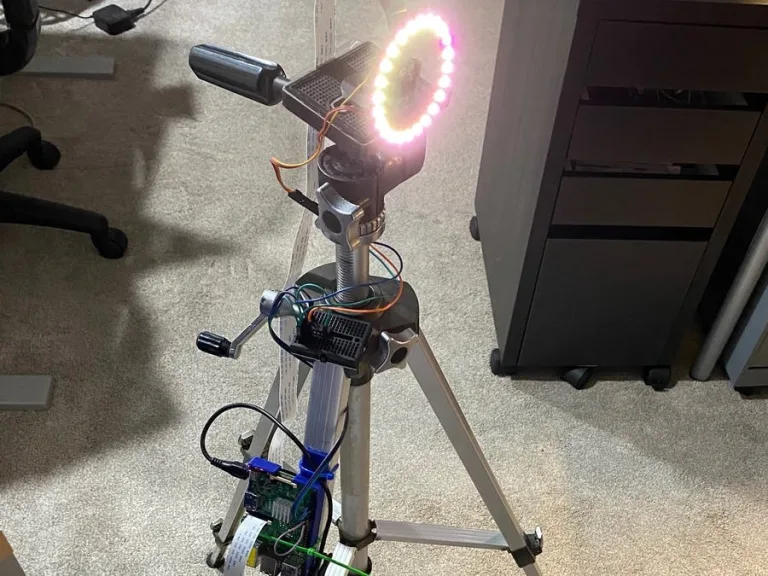
Dr Jon’s project demonstrates the use of a large LED ring based on the WS2812B, made up of 241 LEDs, controlled by a Raspberry Pi Pico or Pico 2 to create advanced Christmas light effects. The goal is to show how a circular LED structure can be used both for decorative animations and as a very low-resolution display, while keeping the software management relatively simple.
The LED module used consists of nine concentric rings, with an increasing number of LEDs from 1 up to 60 per circle, for a total of 241 light elements. Power is supplied at 5 V, while data control is handled by a single GPIO pin on the Raspberry Pi Pico. To ensure electrical stability during the more complex animations, a large electrolytic capacitor is inserted, useful for preventing brown-out phenomena caused by sudden current draws.
Since the Raspberry Pi Pico operates with 3.3 V logic and the WS2812B LEDs require a 5 V data signal, the project includes a small bidirectional logic level converter. This component ensures reliable communication between the microcontroller and the LED ring, avoiding transmission errors during operation.
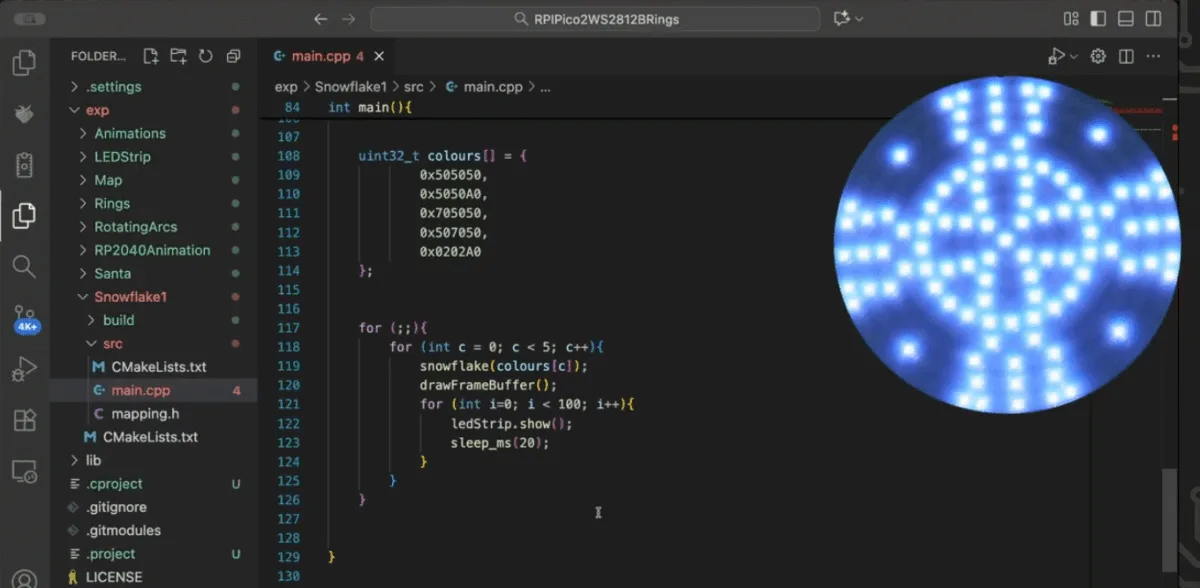
From a software point of view, the LEDs are controlled using the “pico_led” library. Initially, the ring is defined as a single strip of 241 LEDs. Then, the strip is logically divided into several sections, each corresponding to one of the concentric rings. This approach allows each circle to be managed separately, applying different colors and effects such as rotating arcs, circular animations, and Christmas bauble-like light decorations.
The project also explores using the LED ring as a low-resolution display. To achieve this, a square frame buffer of about 17×17 effective pixels is created. Each LED is associated with an X-Y coordinate using a pre-calculated mapping table. This makes it possible to display simple images, such as a Santa Claus icon, and to generate dynamic animations like snowflakes, obtained by reflecting patterns within the frame buffer.
In the final demonstration, the Raspberry Pi Pico runs several animations in sequence: Christmas decorations, static images, animated arcs, and snowflakes. The result is a festive light decoration that combines electronics, programming, and creativity, showing the potential of the RP2040 microcontroller in driving complex LED systems.