Motorized welding turntable with Arduino UNO
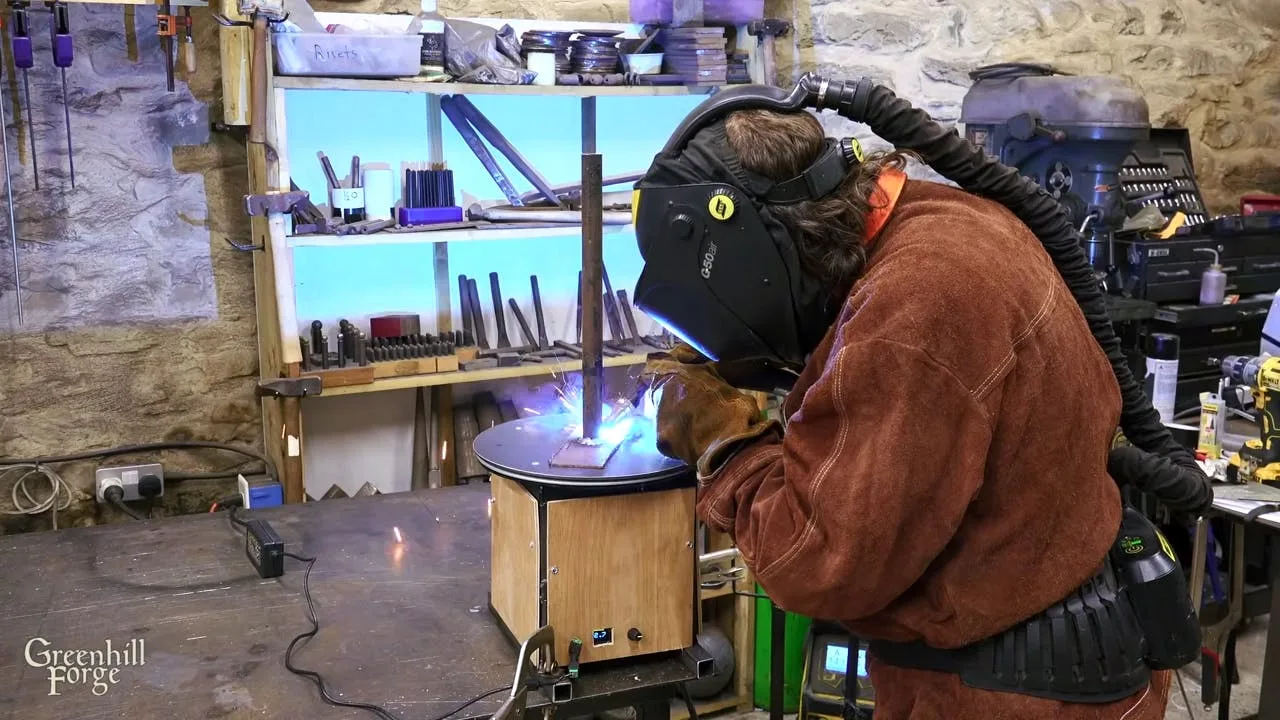
Building a motorized welding turntable solves a common problem: welding around circular or cylindrical objects without walking around the workpiece. Greenhill Forge’s project creates a large motorized lazy Susan with adjustable speed and a modest budget. The table rotates the piece under the torch, so the welder stays still and both hands are free to guide the arc.
The heart of the system is a stepper motor mounted under the table surface. Rotation passes through a gear reducer and a standard spider coupling, which transmits motion to the top plate. The reducer increases torque and lowers speed, so the table moves smoothly even with heavy parts. Everything is controlled by an Arduino UNO Rev3 board, which drives the motor and reads user commands.
Speed control and user interface
The user adjusts rotation speed with a rotary encoder. The knob is comfortable to use even with welding gloves. A small OLED screen shows the set speed, so control is immediate and precise. The firmware on the Arduino UNO reads the encoder, updates the display, and drives the stepper motor with the correct pulse frequency.
For those who want to replicate the project, choosing components is straightforward. A Uno R3 with ATmega328 is the same board used in the original project. A NEMA 17 stepper motor rated at 1.2 A has the right torque for a table of this size, which rotates through a reducer anyway. A 12 mm rotary encoder with knob connects directly to digital pins and can be turned even with welding gloves. Finally, a 128×64 OLED display shows parameters clearly.
- Stepper motor with gear reducer for torque
- Spider coupling to connect shaft and table
- Lazy Susan bearing for rotating support
- Rotary encoder for adjustment
- OLED display for visual feedback
Grounding through the shaft
An important detail is grounding management. In welding, current must return to the generator through the workpiece. If the turntable is not grounded, current passes through the lazy Susan bearings, causing arcs that damage them quickly. Greenhill Forge solves the problem with a ground strap that runs through the motor shaft.
The strap maintains conductivity between the table surface and the workpiece. This way, welding current has a dedicated path and the bearings stay protected. The strap is a wear item, but with normal use it should last a long time. Also, replacement cost is minimal, so maintenance stays economical.
The project is documented in a Greenhill Forge video, which follows the entire process: cutting and welding the frame, mounting the motor under the table, and grounding. At the end, the table is shown in action during a real weld, with speed adjusted on the fly.
Why build a turntable
This project appeals to both beginners and experienced welders. Construction is simple and requires few tools. Moreover, electronic control with Arduino UNO opens the door to future modifications, such as programmed rotation or foot pedal control. The modest cost makes the project accessible to many makers.
The welding turntable is an example of how a stepper motor, an encoder, and an OLED display can turn a simple support into a professional tool. Well-designed grounding protects components and ensures quality welds. Finally, adjustable speed lets you adapt rotation to any type of work.
Source: https://youtu.be/WQSzLMcc9zQ?si=DB7dDrRwHsfXU1OI