
RECEIVER WITH 4-BIT OUTPUT AND HCS ROLLING CODE
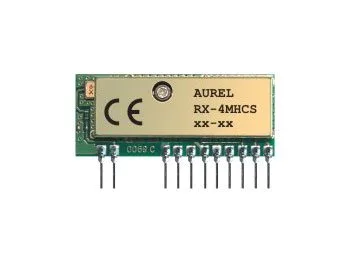
SKU 8110-RX-4MHCS-4BEAN 8219671058520Item type: AssembledRF receivers
Description
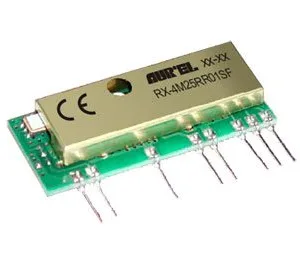
Hybrid superheterodyne module containing a UHF radio receiver tuned to 433.92 MHz, equipped with an OOK amplitude demodulator and output pulse shaper, completed by a decoding circuit that allows it to respond correctly to the TX-12CH. The decoding inside is implemented by a microcontroller that runs the HCS protocol and recognizes the commands sent by the transmitter; in practice, the decoder has 4 output lines that express in binary format on a 4-bit word the channel number, i.e., the number of the key pressed on the TX. Each output is interfaced with an NPN transistor, so it is inverted logic, i.e., active at a low logic level; the output transistors are all configured as open-collector. The module has one input and one output respectively for a button and for connecting an LED, both necessary for the self-learning procedure; indeed, being a rolling code, the remote control requires that the receiver be paired with the transmitter, i.e., that it learns the base code and whatever else is needed to synchronize with it.
Ideal as a control element in devices such as gate openers, anti-theft systems, and generally in applications where channel encoding is required. Applications: light controls, home automation, remote controls, access control.
Keeloq Algorithm
- Keeloq encoding is one of the most widely used in high-security remote controls because it implements a code variation algorithm that is practically non-repeatable and inviolable; building the decoder is quite simple, because Microchip makes available the software to implement in the micro that performs this function. Although used by most remote control manufacturers, the HCS301 guarantees very high security of use because it allows the creation of customized products: in fact, each manufacturer has the possibility to customize their production with a 64-bit Manufacturer Code, which represents one of the starting data to generate the encryption key with which the variable part of the 66-bit pulse train produced by the HCS301 encoder is generated. Each individual chip is also identified by a unique 28-bit code called, precisely, Serial Number. This data is also stored during chip programming by the transmitter manufacturer. Ultimately, each manufacturer programs the chips with their own 64-bit Manufacturer Code (the same used in the receiver’s decoding software) and a 28-bit Serial Number, unique for each HCS301.
- The Manufacturer Code is a 64-bit code specific to each manufacturer (OEM for which Microchip produces the HCS30x series encoders) that is stored both in the EEPROM of the HCS301 encoder and in the memory of the microcontroller used as decoder and in which the Keeloq software is implemented. To work, an Encoder and a Decoder must have the same Manufacturer Code, otherwise the variable code that the receiver (the decoder) expects will always be different from that generated by the encoder.
- The Serial Number is a progressive 28-bit code with which HCS chips are differentiated during programming. The Serial Number thus allows distinguishing one transmitter from another. During TX-RX pairing, this code is learned by the receiver; during normal operation, the encoder first checks that the Serial Number of the transmitting TX is among those stored and only then proceeds to decode and verify the other data contained in the incoming string.
Technical details
| Power supply | 5 Vdc |
|---|---|
| Current consumption | 3 mA |
| Frequency | 433.92 MHz |
| RF sensitivity | -106 dBm |
| Open collector output | 100 mA |
| Operating temperature | -20 ~ +80°C |
| Dimensions | 39.5 x 17.5 mm |
Related products
-
 RF receivers
 -
 RF receivers
 -
 RF transmitters
 -
 RF receivers
 -
 RF receivers
 -
 RF receivers
 -
 RF receivers
 -
 RF receivers