SonicFly: the drone that follows another drone using only sound
SonicFly is a system that lets a drone follow another drone using only the sound of the leader’s rotors. No GPS, no cameras, no radio communication. The follower listens, calculates, and pursues. The project, built by Yanbaihui Liu, demonstrates that acoustics can be the sole source of relative perception in flight.
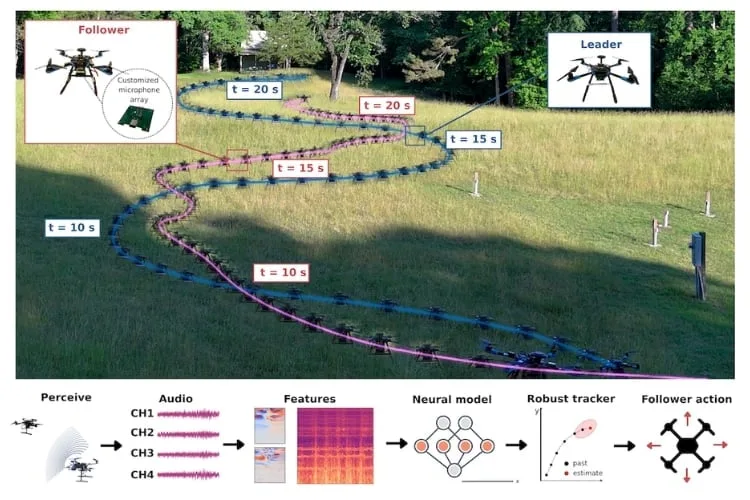
The heart of the system is an array of four ICS-43434 MEMS microphones, synchronized via an ESP32-S3 microcontroller. The microphones are spaced 75 mm apart. This configuration captures ambient sound with enough precision to estimate the direction and distance of the source.
The most interesting part is signal separation. The leader uses two-blade propellers, while the follower uses three-blade ones. This choice creates distinct harmonic frequencies. The system can therefore isolate the leader’s sound from the noise produced by the follower itself. The board with integrated display is not needed here, but could be useful for debugging and monitoring.
How sound becomes a position map
The captured audio is transformed into spectrograms. To these are added the interaural phase difference and level difference features between the microphones. This data represents the raw material for the neural network.
The neural network estimates the leader’s relative position, namely bearing and distance. Bearing is the horizontal angle relative to the follower. Distance indicates how far the leader is. The estimates are not perfect, but they are stable enough for flight control.
Before reaching the flight controller, the estimates pass through a Kalman filter. The filter uses confidence-based gating. In practice, it discards unreliable readings and smooths out oscillations. As a result, the follower’s movement is fluid and responsive.
Outdoor test numbers
The system was tested in outdoor chases under various conditions. The target separation from the leader was 3.5 meters. The follower maintained an average distance with an error of 1.34 meters. The average bearing estimation error, after filtering, was 31 degrees. These numbers show the system works, even if it is not perfect. The 31-degree bearing error is significant, but the Kalman filter partially compensates. The result is stable tracking, useful for real applications.
Why this matters
Because GPS and vision fail in many environments. Under canopies, in tunnels, near metal structures, the GPS signal degrades. Cameras suffer with low light or backlighting. Sound, on the other hand, is always present.
Why SonicFly is a project worth studying
SonicFly offers a complementary method to GPS and vision. It does not replace them in every scenario, but it works alongside them where they fail. The combination of microphone array, neural network, and Kalman filter is an example of advanced sensory perception.
For those who want to rebuild the project, the main components are the ESP32-S3 and the ICS-43434 microphones. The ESP32-C6-Zero board could be an interesting alternative, although the original project uses the S3. The 75 mm spacing between microphones is critical: it must be respected.
- Array of 4 synchronized MEMS microphones
- Neural network for bearing and distance estimation
- Kalman filter with confidence-based gating
- Acoustic separation via propellers with different blade counts
The project page contains full details, including calibration data and tests. Those working in robotics or sensory perception will find useful insights. Sound, often ignored, is a powerful resource.
Finally, a practical note. If you want to experiment, start in a controlled environment. An open field, without wind, with reflective surfaces far away. Microphone calibration is delicate, but the final result is worth the effort.
Source: https://arxiv.org/abs/2608.00401