
RP2040 Breakout Board
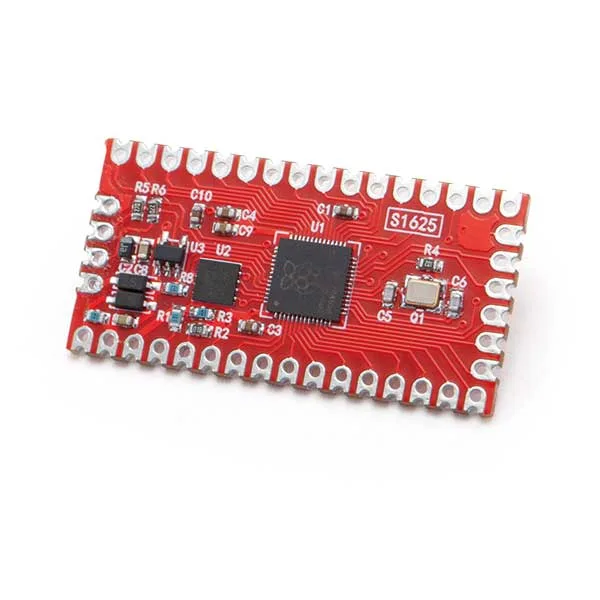
SKU 7100-FTR2040Item type: Assembled, BoardDevelopment systems, Raspberry Pi
Description
| Our Advanced RP2040 Prototyping Board integrates perfectly with the Raspberry Pi Foundation programming environment. This board, based on the powerful RP2040 microcontroller, was designed to give you flexibility and power, making every project of yours achievable and versatile like never before.
Equipped with a Dual ARM Cortex-M0+ running at 133MHz and 264 kB of SRAM, the RP2040 board lets you handle complex projects with ease. Its architecture is enhanced with support for up to 16 MB of external Flash memory, accessible via a dedicated QSPI bus, guaranteeing space and speed for your every need. What sets this board apart is its customisable design: solderable pins (see related products) let you adapt the board to your specific needs. Whether you want to plug it into a breadboard or solder it directly like a surface-mount IC, the FTR2040 fits perfectly. The screen printing visible on the top side further simplifies use and component orientation. For USB connectivity, an additional breakout board is available, expanding your board’s connection options (see related products). Every detail has been designed to give you unprecedented flexibility: from the programmable LDO regulator to the two on-chip PLLs, right up to the 30 GPIOs, which include analogue inputs, UART, SPI, I²C, PWM and much more. With the Advanced RP2040 Prototyping Board, every project of yours will come to life simply, efficiently and with incredible versatility. Experiment without limits, create without boundaries. Add this technological marvel to your electronics lab now! A free course dedicated to the new RP2040 chip developed by the Raspberry Pi Foundation is available, useful for learning how to use the product presented here. |
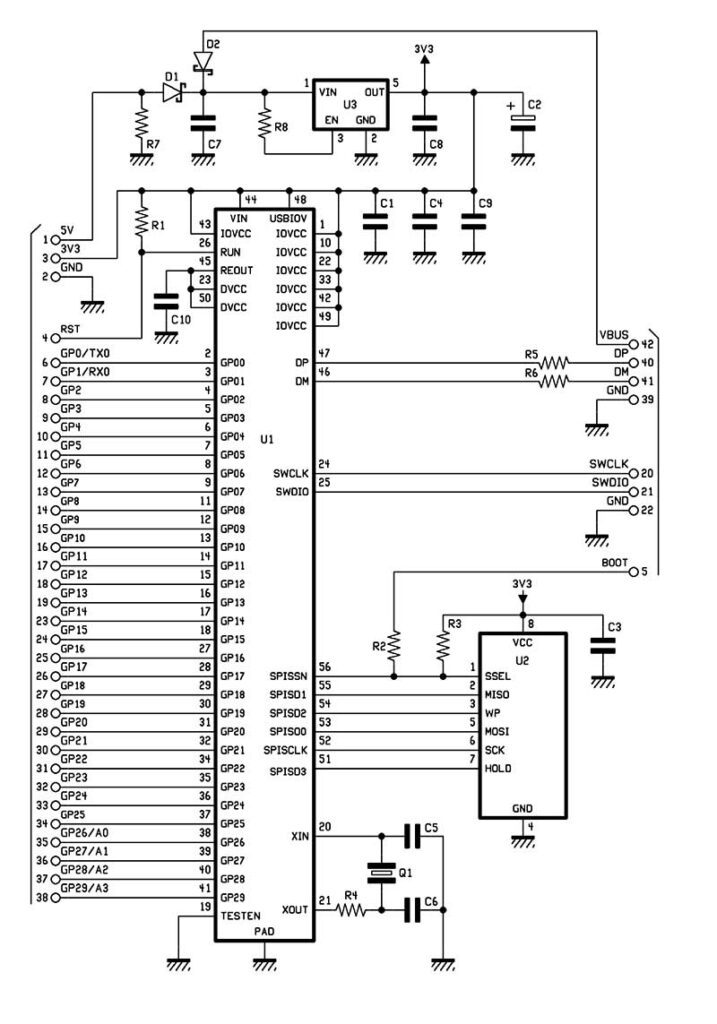
| Circuit diagram |
 |
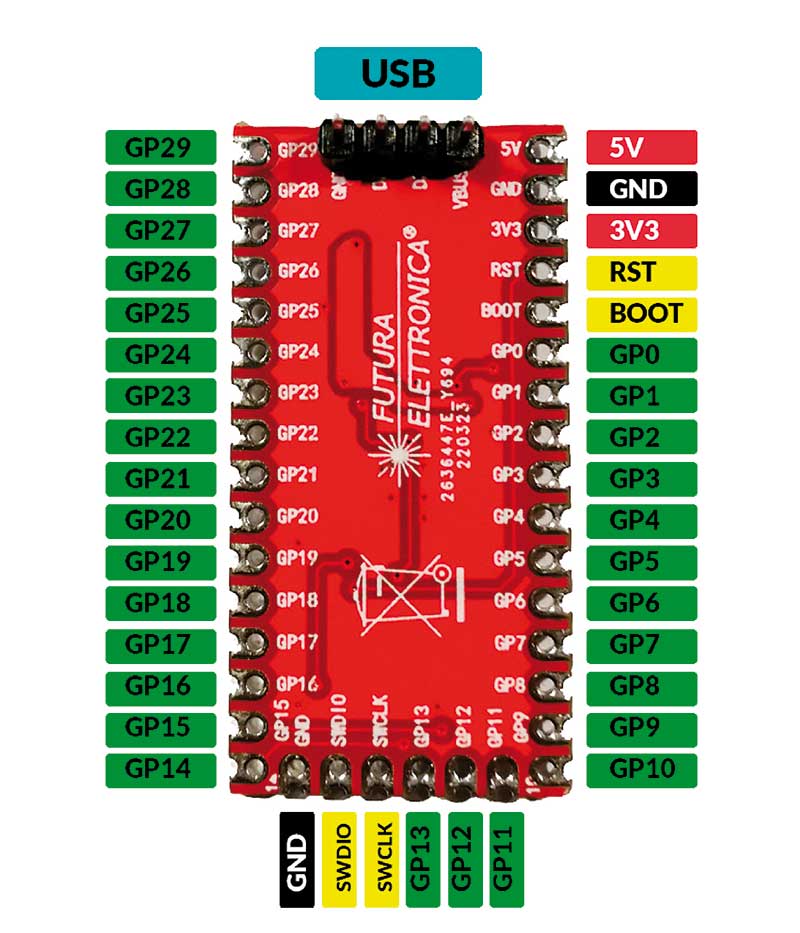
| FTR2040 board pinout |
 |
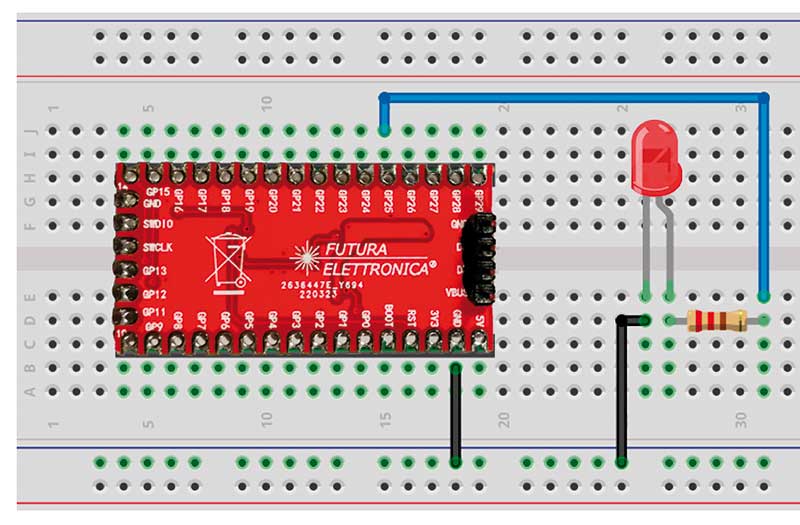
| Example of an LED connected to the FTR2040 board |
 |
| RP2040 features |
|
| Breakout boards |
| Breakout boards are prototyping boards with the component in question already soldered on, whose connections are brought out to the edge of the board on easy-to-use pads with standard pitch and termination; the connections are generally pads on a 2.54 mm pitch, like those of classic DIP ICs. To make life easier for anyone who wants to use SMD components but lacks the means or skill to solder them, a number of ICs have been identified (including sensors, switching power supplies, battery chargers, linear amplifiers, etc.) and mounted on ready-to-use boards. These breakout boards are both an aid for those who want the best of SMD electronics already available in a “traditional” format, and for those who -while able to work with SMD components- need to have such components available on prototyping boards to fit into existing circuits and run tests, or to build prototypes that integrate the functions of the relevant ICs, before making the final PCB of a piece of equipment. |
Related products
-
 Lab cables
 -
 Displays
 -
 Raspberry Pi
 -
 Mains power supplies
 -
 Raspberry Pi
 -
 Accessories
 -
 micro:bit
 -
 Raspberry Pi