Inflatable Robotic Dinosaur: The T. rex You Assemble Yourself
An eight-meter-tall robotic dinosaur that one person can inflate, assemble, and then fold back into a bag. It’s not a toy: it’s the most striking demonstration of AirForce, a fabrication system developed at the Hasso-Plattner-Institut in Potsdam, in Patrick Baudisch’s group, and presented at the CHI 2026 conference. The first author is Lukas Rambold.
The idea is simple: a single inflatable tube that serves as both the load-bearing structure and the muscle. Large animated structures are usually a rigid truss with motors on top. Here, the truss is the tube, and the actuators are carved from the same tube. The hardware disappears, the weight disappears, and at the end of the job nearly all the material can be recovered.
How to build a structure with a single tube
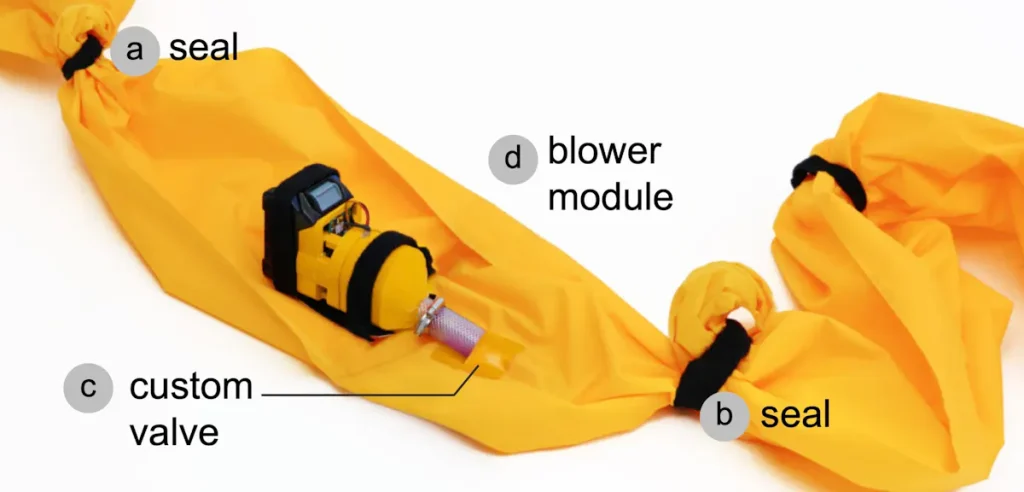
The process is step-by-step, and none of the steps requires two pairs of hands. You start with the deflated tube and add the constrictions, i.e., the clamps that close it at chosen points and define the segments. Then you mount the custom fittings and blowers, and the segments are partially inflated. At that point the tube is knotted to form the truss, and only at the end is it fully inflated: it’s the final inflation that tensions the structure and makes it load-bearing.
The same structure can then be untied and re-knotted into a different shape, recovering practically all the material. This is what distinguishes this approach from large-scale 3D printing, where each piece is born and dies with the project it was made for.
Three actuators made from the tube itself
The interesting part for designers is that the authors didn’t invent one actuator, but three, each for a different direction of force. They were measured on a test bench, and these are the peak values stated in the paper:
- Instability actuator — pushes, exploiting the controlled collapse of the tube: 480 N
- Muscle actuator — pulls, shortening when pressurized: 1420 N
- Telescopic actuator — for large forces: 2330 N
To avoid leaving actuator placement to intuition, the group wrote a plugin for Blender: you draw the structure, choose where to put the actuators, and the plugin exports the fabrication instructions, i.e., where to constrict the tube and where to attach the blowers.
The T. rex and the platform that lifts a person
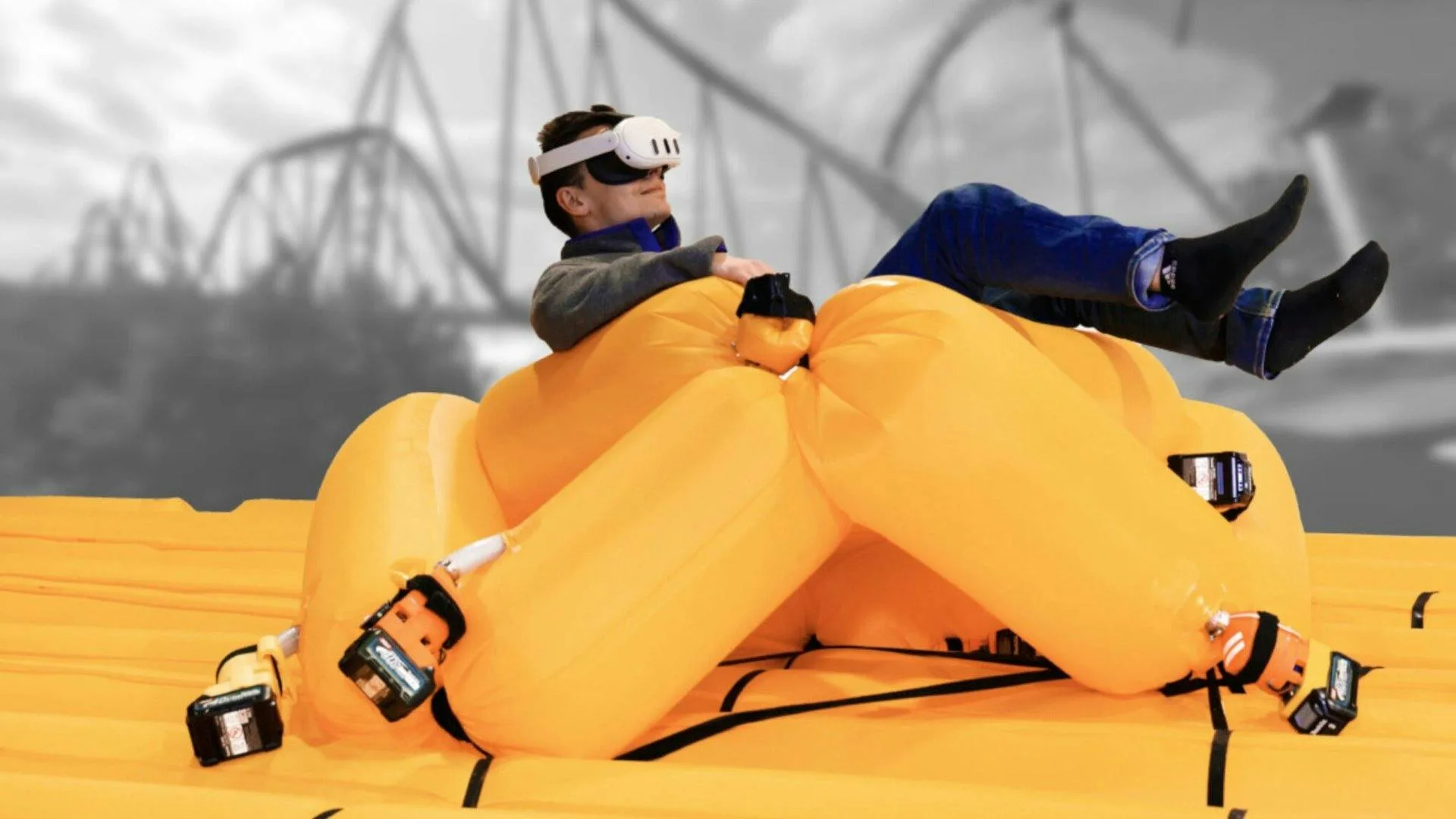
The two built demonstrations serve to show the two extremes. The dinosaur is eight meters tall and animates on three degrees of freedom, with custom components developed specifically for it. The second is a motion platform with six degrees of freedom capable of lifting a person: the same technology, asked to carry a real load instead of putting on a show.
It’s worth saying clearly, because the name is misleading: AirForce is a pun between air and force. It has nothing to do with the military air force — it’s university research in human-machine interaction and personal fabrication.
Why you should look at it, even if you don’t build dinosaurs
The force-to-weight ratio of a pneumatic actuator made from a tube is hard to beat with a motor and gearbox, and transport is another matter: the deflated structure fits in a trunk. These are the three constraints — weight, transport size, and solo assembly — that recur in stage design, trade fair setups, temporary installations, and field equipment. The actuators are documented with numbers, so this is material you can reason about, not just a video to watch.