
2-Relay Ethernet Board
SKU 7626-ETH-RLY02EAN 8219671020565Item type: AssembledEthernet & Wi-Fi, Ethernet devices
Description
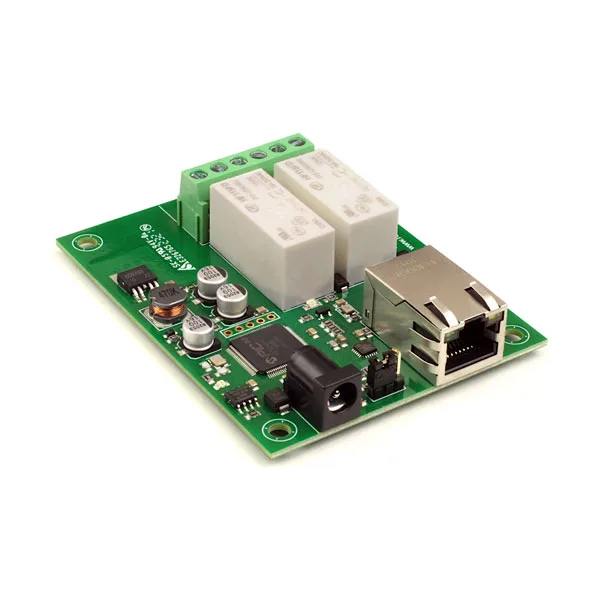
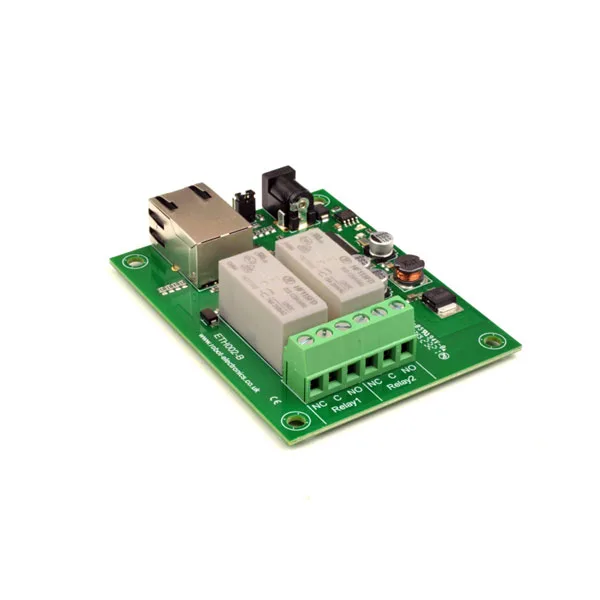
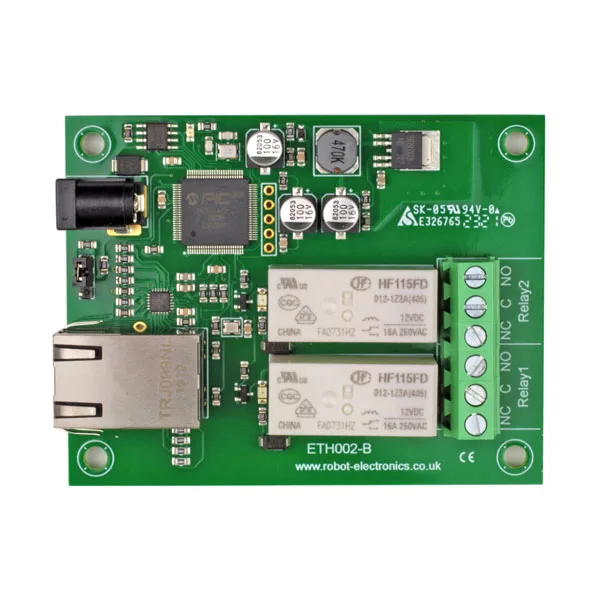
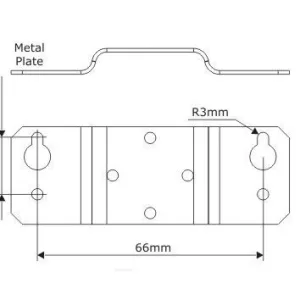
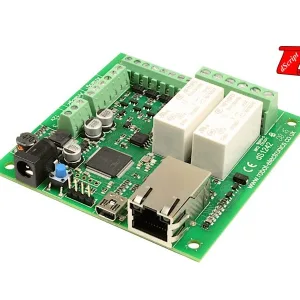
| Devantech ETH002-B board with an Ethernet interface and two volt-free relay outputs rated up to 16 A. It can be controlled over a LAN (Local Area Network) or across the Internet (webpage). A free app is also available for Android and iPhone. It offers a 100 MB full duplex Ethernet connection, a configurable host name and the MQTT protocol with optional TLS encryption. The board is supplied ready assembled and tested. It has 2 relay outputs, N.O. and N.C. (24 Vdc or 250 Vac / 16 A), each with its own status LED. Power supply: 12 Vdc-500 mA, dimensions: 85 mm (length) x 66 mm (width) x 20 mm (height). Operating temperature: -40°C to +70°C. | |
|
First test
|
|
|
Network connection and HTTP access IP addresses and DHCP server: the easiest way to use the ETH-RLY02 board is to connect it to a network with a DHCP server. In that case the ETH-RLY02 will have its IP address assigned automatically by the DHCP server. |
|
|
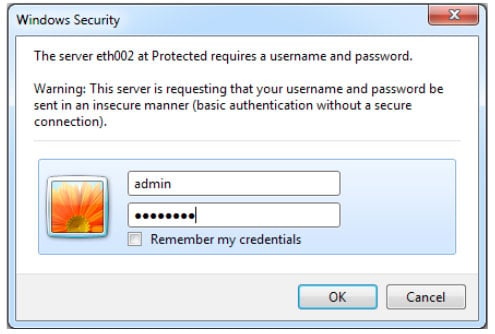
Access from the browser Power up the board and plug in the ethernet port, then start your browser and type http://eth002 in the address bar (this only works on Windows); you should see the screen below. |
|
 |
|
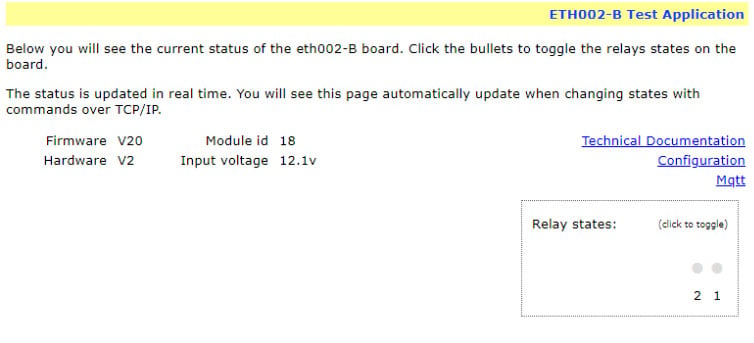
| You should then see the web page below, from which you can switch the relays on and off, reach the technical documentation (in English) and the network settings. | |
 |
|
|
Configuration
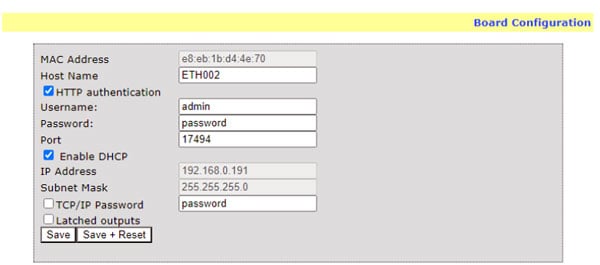
Clicking the configuration link lets you set the IP address and the subnet mask. The configuration page also lets you set a password that will then be required to change the state of the relay or of the digital outputs using TCP IP commands (TCP/IP password section). All the settings are saved in memory, so take care to remember your user name and password! The default password settings are shown in the picture below. There is also a latched outputs option, which automatically saves the state of the relays in the event of a power failure.
|
|
 |
|
|
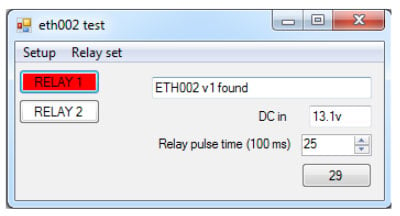
Test program and sample source code: you can study the source code to see how it works, or use it as a starting point for your own application.
|
|
 |
|
| Visual Studio Express is supplied free of charge by Microsoft: http://www.microsoft.com/exPress/download/
App for Android and iPhone |
|
|
Access from the Internet
|
|
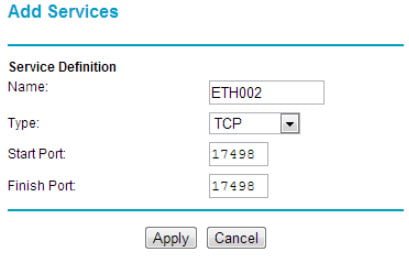
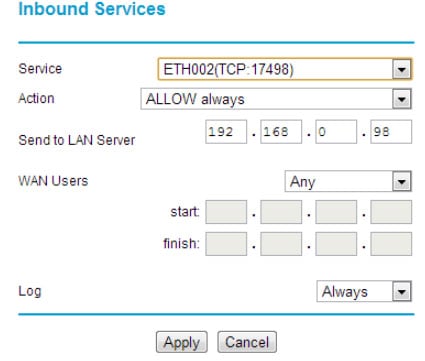
| The board can also be controlled over the internet through a broadband router. To reach the board from the internet you will need to open communication port 17494 (0x4456), which is set up to accept incoming TCP connections. Take care not to open any other port. Because there is such a wide variety of routers about, we cannot give the details for every one of them. If in doubt, ask your system administrator for help. Below we show how to open a port on a Netgear DG834 router. | |
 |
|
| After logging in to your router configuration page, the first thing to do is create a new service. Click the “Services” menu, then “Add Custom Service”. Enter a name for the service, select TCP and enter the start and end port address. Click “Apply”. | |
 |
|
|
Now go to the “Firewall Rules” menu and click “Add” in the inbound services section. Select the ETH-RLY02 service and Always allow. The “Send to LAN Server” IP address is the IP address of the ETH-RLY02 board, 192.168.0.96 in the example above, but check what it is on your own network. Click “Apply” and that is all. The ETH-RLY02 can now be reached over the internet. |
|
|
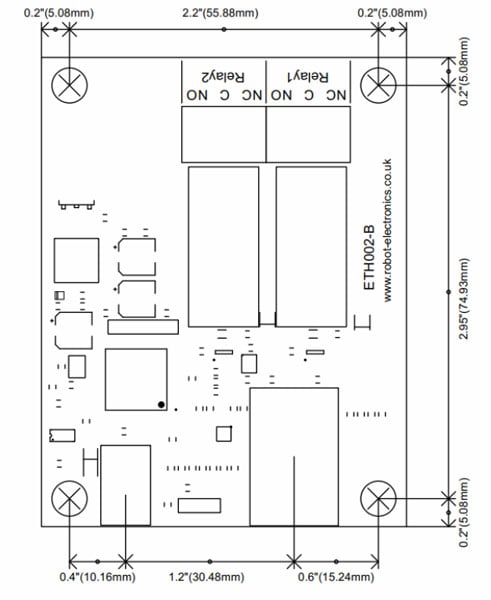
Dimensions
|
|
 |
|
| Technical specifications | |
|
|
|
Documentation and useful links
|
|
|
Technical details
| Relay outputs | 2 |
|---|---|
| Power supply | - 12 Vdc mains adaptor |
| Configuration and test interface | HTTP (webpage) |
| Control interface | TCP/IP over Ethernet |
| Relay rated current | up to 16A@24vdc or 250vac |
| Ethernet | 100mb full duplex |
You may also like…
-
 Ethernet devices
 -
 Ethernet & Wi-Fi
Ethernet Board with 4 x 16 A Relays, 8 Digital I/Os and 4 Analogue Inputs
€78.69excl. VAT€96.00incl. VAT
Related products
-
 Ethernet devices
 -
 Ethernet devices
 -
 Ethernet & Wi-Fi
 -
 Ethernet & Wi-Fi
 -
 Ethernet & Wi-Fi
Ethernet Board, 2 Relays 16 A, 4 Digital I/O and 2 Analog Inputs
€56.48excl. VAT€68.90incl. VAT -
 Ethernet devices
 -
 Ethernet & Wi-Fi
 -
 Ethernet & Wi-Fi