
Colibrì – RGBW LED Power Driver

SKU 7305-COLIBRIEAN 8219671075732Output voltage: Automatically adjustedItem type: AssembledControllers & drivers, LED & strip drivers
Description
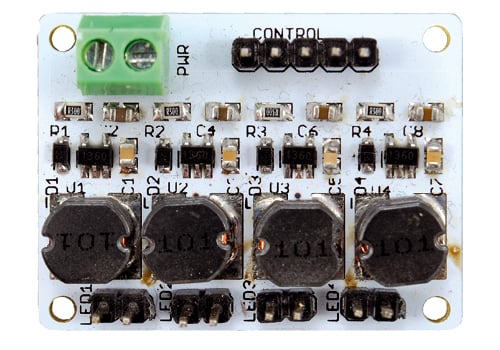
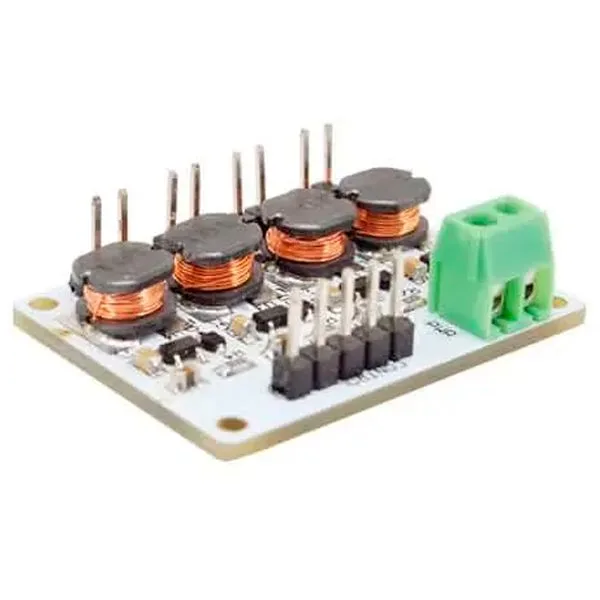
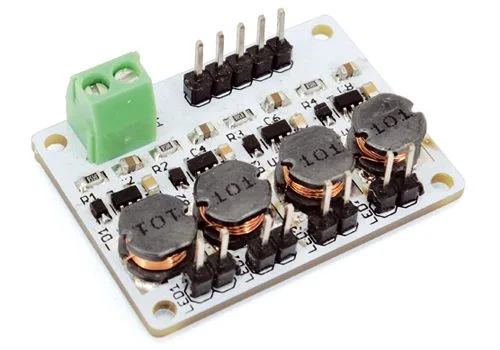
Compact 4-channel LED driver capable of driving 4-color RGBW (Red, Green, Blue, White) LEDs, easily varying brightness and color. It can drive elements with a maximum absorption of 1 Ampere per channel, receive PWM command signals, and accept a supply voltage between 6 and 36 volts. The high supply voltage it can handle also allows driving multiple LEDs in series, thus creating lamps and spotlights; for example, with a voltage of 20 volts it is possible to drive a maximum of 20V/3.4V = 5 white LEDs in series per channel.
Note: The board is supplied with all SMD components already soldered, while through-hole components (terminal block and strip) are supplied to be soldered.
RGBW LEDs…
As is well known, LEDs must be driven at constant current and not constant voltage, to obtain maximum efficiency and avoid “burning” them (remember that the variation of current in diodes is exponential, so small voltage variations cause large current variations). The main technique to modulate their current and therefore brightness consists of feeding them with a PWM signal, that is, a rectangular waveform voltage whose duty cycle is modulated.
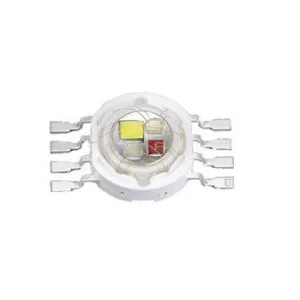
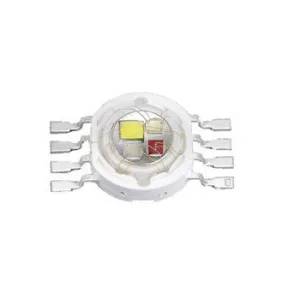
Although to obtain white light it is sufficient to turn on red, green, and blue LEDs together (the proportion between the brightness of red, green, and blue determines the white hue, which can be warm or cold), the addition of a white LED allows obtaining much “cleaner” whites than what can be achieved by mixing the three base colors; it is also possible to use all four together to obtain greater luminous power.
To explain why, for evaluating an RGBW LED, the forward current must be taken into account, let’s take a 4-watt four-color LED, power distributed among four LEDs that usually have a driving current of 300 mA (forward current); since the voltage drop across the LEDs varies by color, we have different powers for the various LEDs, that is:
P_red = (2.2÷2.5V) • 300 mA = 0.66÷0.75 W P_green = (2.5÷2.8V) • 300 mA = 0.75÷0.84 W P_blue, white = (3.2V÷3.4V) • 300 mA = 0.96÷1.02 W
where in parentheses the minimum and maximum voltage drops across the diodes are indicated. Considering the maximum values, we have a total power equal to: P_tot = 0.75 + 0.84 + 2.04 W = 3.63 W, therefore quite close to what is declared.
For 12-watt LEDs things change a bit, since the declared operating current amounts to 700 mA; now the powers become 1.75 W for the red LED, 1.96 W for the green LED, and 2.38 W for white and blue. With these values, the maximum overall power becomes: P_tot = 8.47 W. This value is well below what is declared, although it remains a considerable power. The declared power for RGBW LEDs is therefore to be understood as the maximum when driving each LED at maximum power, thus with currents of different values.
Technical details
| Power supply | from 6 Vdc to 36 Vdc |
|---|---|
| Operation | switching |
| Maximum output current | 1 A per channel |
| Brightness control (dimming) | both analog and digital |
| Number of channels per module | 4 |
| Dimensions (mm) | 27.6x37.3 |
You may also like…
-
 LEDs
LEDs -
 LEDs
LEDs -
 Arduino
Related products
-
 LED & strip drivers
 -
 Controllers & drivers
 -
 LED & strip drivers
 -
 Controllers & drivers
 -
 LED & strip drivers
 -
 Controllers & drivers
 -
 Controllers & drivers
 -
 Controllers & drivers