
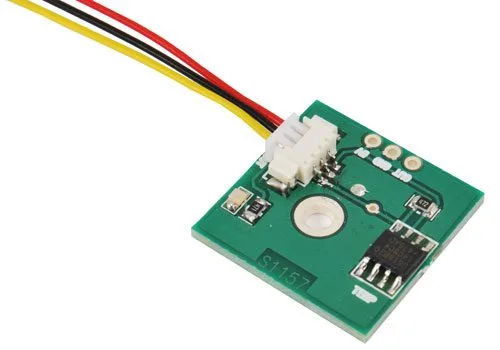
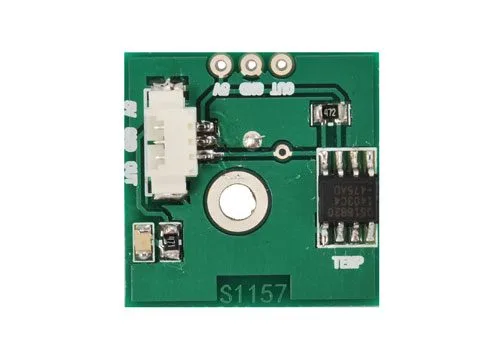
DS18B20 temperature sensor – assembled board
SKU 7100-BREAKOUT001EAN 8219671068734Item type: AssembledSensors, Sensors
Description
Breakout board based on the DS18B20 semiconductor temperature sensor (TSSOP version) from Maxim Dallas. The sensor provides a digital output signal, so it must be interfaced with a microcontroller or microprocessor that queries it according to the specified protocol. The DS18B20 thermal sensor connections are essentially three: the two power pins (Vcc and GND) and the data line (DQ), available via a 3-wire cable with a 1.25mm-pitch JST connector. The DS18B20 communicates using the One-Wire protocol, which allows data communication over a single wire (referenced to ground, of course). For everything to work correctly, the data channel requires a pull-up resistor, available on the breakout board. The DS18B20 measures temperatures from -55°C to +125°C with an accuracy of 0.5°C. Each sensor has a 64-bit serial code stored internally, allowing a large number of sensors to be used on a data bus. Applications include thermostatic controls, industrial systems, consumer products, thermometers, etc. Dimensions (mm): 22×22.
Click here to read the full article published in Elettronica In magazine
Breakout boards
Breakout boards are prototyping boards containing the relevant component already soldered, with connections brought out to easily usable pads in terms of pitch and termination; generally, the connections are 2.54mm-pitch pads, like those of classic DIP ICs. To help those who would like to use SMD components but lack the means or skills to solder them, a number of ICs (including sensors, switching power supplies, battery chargers, linear amplifiers, etc.) have been identified and mounted on ready-to-use boards. These breakout boards are both an aid for those who want the best of SMD electronics already available in a “traditional” format, and for those who—even if able to work with SMD components—need to have such components available on prototyping boards to apply them to existing circuits and run tests, or to build prototypes that integrate the functions of the relevant ICs before making the final PCB of a device.
Related products
-
 Sensors
 -
 Sensors
 -
 Sensors
 -
 Sensors
 -
 Sensors
 -
 Sensors
 -
 Sensors
 -
 Sensors