
FM receiver kit 76-108 MHz
SKU 1606-KITRADIOFMEAN 8219671101981Item type: KitEducational kits
Description
|
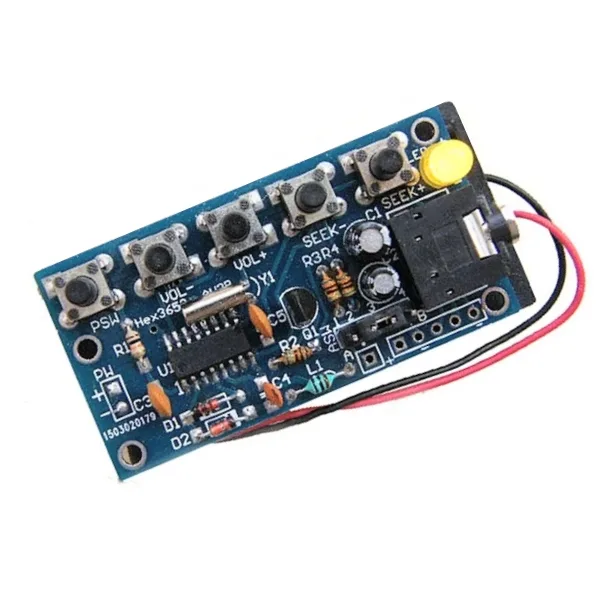
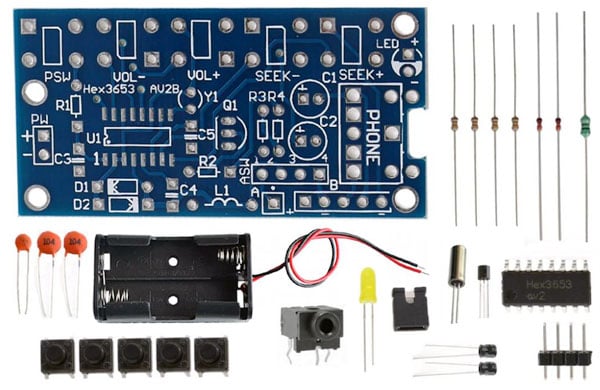
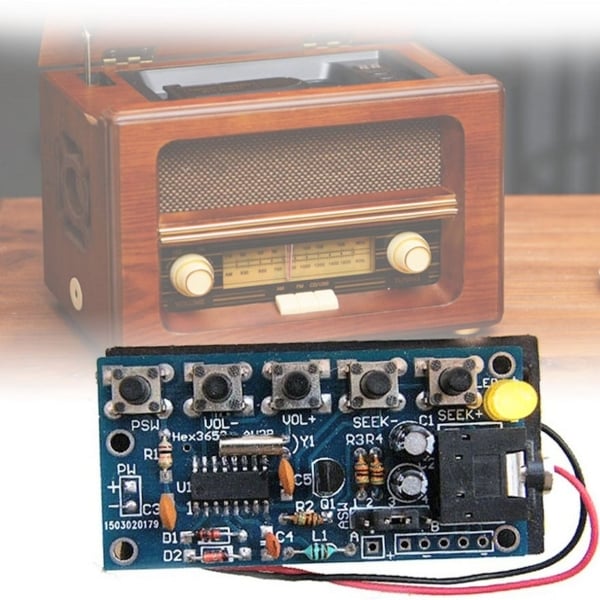
The buttons set the volume (VOL- and VOL+), search for stations (SEEK- and SEEK+) and switch the unit on or put it in standby (PWS). Tuning covers 76 to 108 MHz in steps that are typically 50 kHz; the tunable FM band was made this wide to cover every frequency-modulation broadcast band used around the world. In Italy, and in Europe generally, the FM range typically runs between 87.6 and 108 MHz. It also has a 3.5 mm stereo jack socket for listening on headphones plus a pin-strip connector for hooking it up to an external stereo audio amplifier. Either the headphone or earphone lead can serve as the aerial (exactly as with the FM radio built into mobile phones and smartphones), or a separate aerial (wire or whip) can be used. N.B. batteries, headphones and aerial not included (see related products). |
|
| The Hex 3653 IC |
| This is a complete CMOS FM radio receiver in a 16-pin plastic SOP package, with a crystal-referenced digital synthesis tuning stage (using a 32.768 kHz crystal), 40 dB AM rejection, a multiplex stereo decoder and digital volume control.
The part is rounded off by an LDO regulator that derives the regulated voltage for every stage from the voltage applied between the Vcc pi and GND. The chip runs on 1.8 to 3.6 Vdc and typically draws 17 milliamps (without the LED) with its outputs connected to a high-impedance stage. The stereo output is DC-coupled (which is exactly why it calls for decoupling capacitors), is low impedance and typically accepts 32 ohm loads at 1 kHz, meaning it can be connected to the high-impedance inputs of audio preamplifiers and amplifiers. The stereo decoder gives good channel separation, typically 35 dB, while the audio outputs keep harmonic distortion low, ranging between 0.05% and 1% at full volume. The signal-to-noise ratio reaches about 60 dB, which is more than acceptable. |
Technical details
| Supply voltage | 3 Vdc |
|---|---|
| Current draw | 30 mA |
| Tuning range | 76÷108 MHz |
| Headphone output | 32 ohm |
| Audio output | 200mVrms |
| Modulation | FM |
| Decoding | stereo with 35 dB separation |
| Digital tuning | by pushbuttons |
| Volume control | digital |
You may also like…
-
 Non-rechargeable batteries
Related products
-
 Educational kits
 -
 Educational kits
 -
 Educational kits
 -
 Educational kits
2x3W Powered Speaker Set with VU Meter and Clear Box
Price range: €15.00 through €35.00 incl. VAT -
 Educational kits
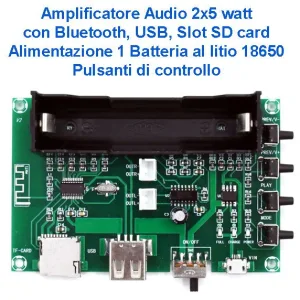
2×5 W Amplifier with Bluetooth and Battery Power – assembled
€8.61excl. VAT€10.50incl. VAT -
 Educational kits
 -
 Educational kits
 -
 Educational kits