
GSM/GPRS/GNSS Board for Raspberry Pi
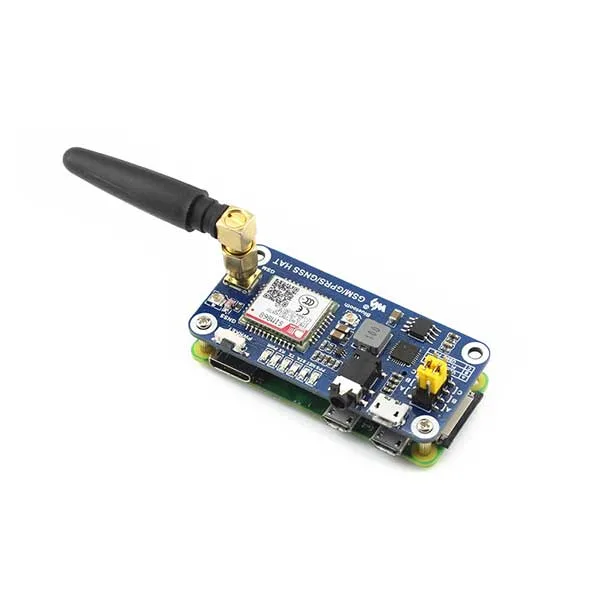
GSM/GPRS/GNSS board for Raspberry Pi based on the SIM868 module
SKU 2850-GSMGPRSRPIEAN 8219671101578Item type: Assembled, Shields & add-onsRaspberry Pi
Description
GSM/GPRS/GNSS board for Raspberry Pi based on the SIM868 module. Compatible with Raspberry Pi 2B/3B/3B+/Zero/Zero W, supports sending SMS, voice calls, GPRS, DTMF, HTTP, FTP, MMS, email, with the possibility of transferring data via Bluetooth. Automatic baud rate detection, board operating status indicated by 6 LEDs, controllable via AT commands. Manual and developer resources available for download.
The Raspberry Pi board is not included.
Package Contents
- 1 x GSM/GPRS/GNSS board
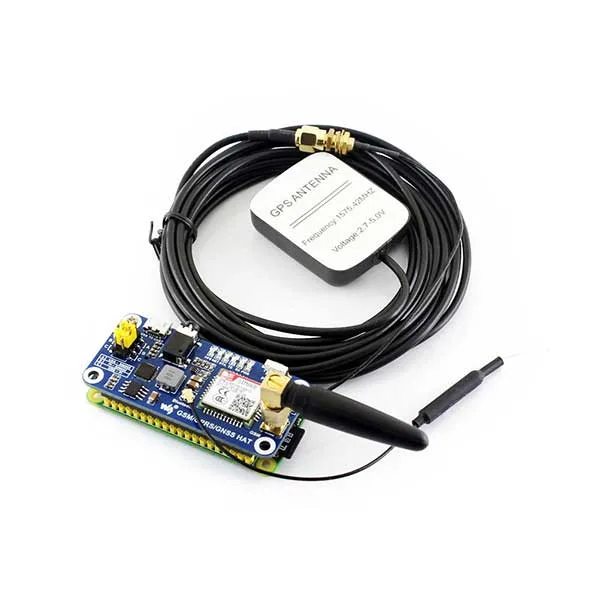
- 1 x GSM antenna
- 1 x External GPS antenna (B)
- 1 x Bluetooth antenna
- 1 x USB A / micro plug cable
- 1 pair of screws for mounting the board to the Raspberry Pi
Technical Specifications
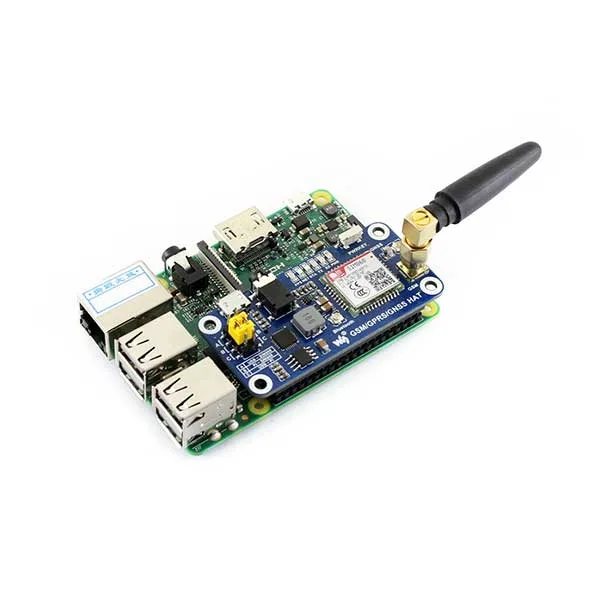
- Compatible with Raspberry Pi 2B/3B/3B+/Zero/Zero W
- Supports SMS, voice calls, GPRS, DTMF, HTTP, FTP, MMS, email, etc.
- Supports GPS, COMPASS, Glonass, LBS base station positioning, omni-positioning
- Bluetooth 3.0, supports data transfer via Bluetooth
- CP2102 USB – UART converter for UART debugging
- Board operating status indicated by 6 LEDs
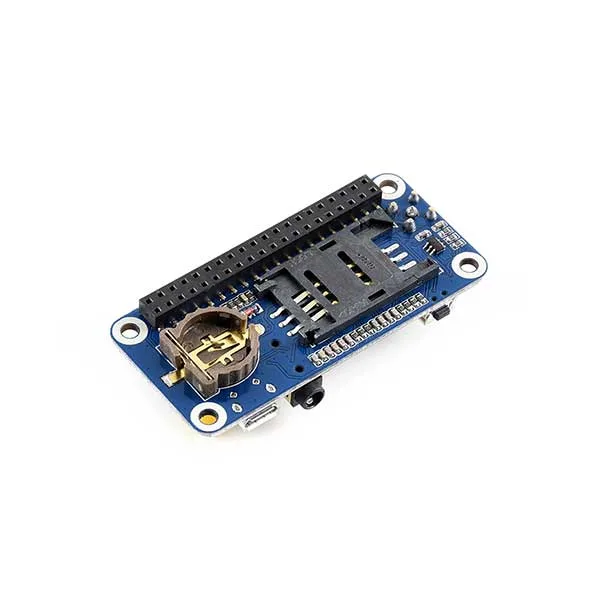
- SIM card slot 1.8V/3V
- RTC with backup battery
- Automatic baud rate detection (1200bps ~115200bps)
- Controllable via AT commands (3GPP TS 27.007, 27.005, and enhanced SIMCOM AT commands)
- GSM/GPRS
- Band
- GSM 850/EGSM 900/DCS 1800/PCS 1900 MHz
- Quad-band auto search
- Conforms to GSM phase 2/2+
- Transmit power
- Class 4 (2W @ GSM 850/EGSM 900 MHz)
- Class 1 (1W @ DCS 1800/PCS 1900 MHz)
- GPRS connectivity
- GPRS multi-slot class 12 (default)
- GPRS multi-slot class 1~12 (configurable)
- GPRS data functions
- Supports PAP (Password Authentication Protocol) for PPP connections
- Supports PBCCH
- Supports USSD
- SMS
- Audio
- Voice encoding/decoding: Half Rate, Full Rate, Enhanced Full Rate, Adaptive multi-rate
- Echo cancellation mode
- Noise reduction mode
- GNSS
- Reception type
- 33 tracking channels
- 99 acquisition channels
- GPS L1 C/A code
- Sensitivity
- Acquisition time
- Cold start: 28s
- Accuracy
- Bluetooth
– Supports AT commands
– Compliant with Bluetooth 3.0 + EDR specifications
– Supports SPP, OPP, HFP/HSP, etc. - Miscellaneous
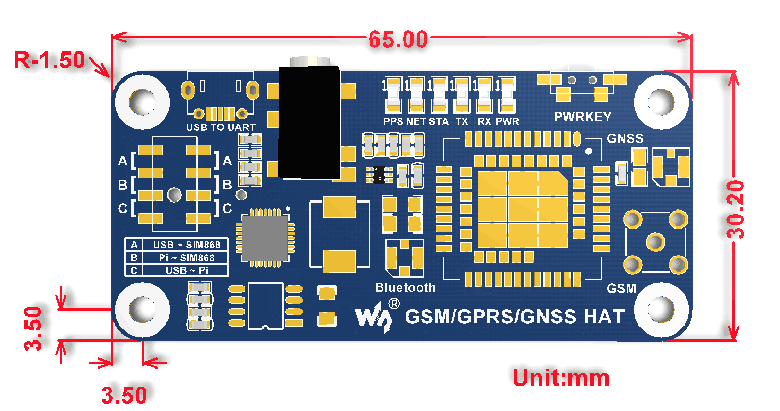
– Dimensions: 30.2mm x 65mm
Board Description
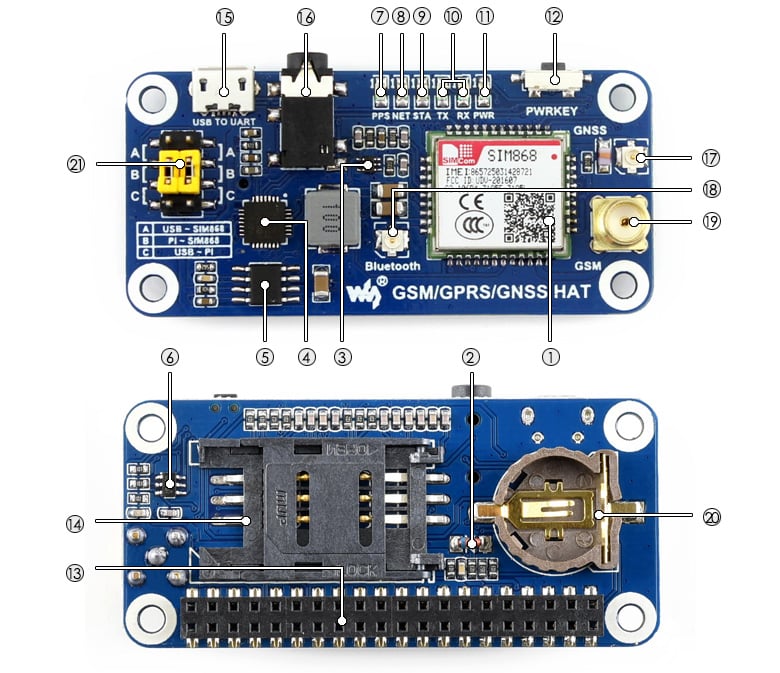
- SIM868 module
- ZMM5V1: regulation diode
- SMF05C: TVS diode
- CP2102: USB – UART converter
- MP1482: power chip
- NDC7002N: voltage level translator
- GPS status indication
- NET indicator:
- blinks quickly when the module is starting up
- blinks slowly after GSM registration has succeeded
- Module STA operating indicator
- SIM868, UART Tx/Rx indicator
- Module powered indicator
- SIM868 control button: hold for one second to power on/off the SIM868 module
- Raspberry Pi GPIO connector
- SIM card slot
- USB – UART interface
- 3.5mm microphone/headphone jack
- GNSS antenna connector
- Bluetooth antenna connector
- GSM antenna connector
- CR1220 battery holder: for RTC backup function
- UART switch
- A: control the SIM868 module from USB to UART
- B: control the SIM868 module through Raspberry Pi
- C: interface to Raspberry Pi from USB to UART
Dimensions
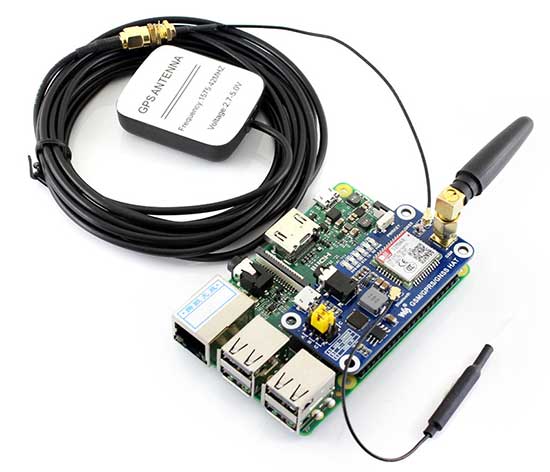
Use with Raspberry Pi
Manual and Developer Resources Download
Technical details
| Supports SIM application toolkit | GSM 11.14 Release 99 |
|---|---|
| Downlink speed | max 85.6kbps |
| Uplink speed | max 85.6kbps |
| Coding schemes | CS-1, CS-2, CS-3, CS-4 |
| Supports modes | MT/MO/CB/Text/PDU |
| SMS storage | SIM card |
| Tracking | -165 dBm |
| Cold start | -148 dBm |
| Hot start | < 1s |
| Warm start | 26s |
| Horizontal position | <2.5m CEP |
| Operating voltage | 5V |
| Operating temperature | -40°C ~ 85°C |
| Storage temperature | -45°C ~ 90°C |
Related products
-
 Lab cables
 -
 Displays
 -
 Raspberry Pi
 -
 Mains power supplies
 -
 Raspberry Pi
 -
 Development systems
 -
 Accessories
 -
 Raspberry Pi