
Ozone Sensor Module
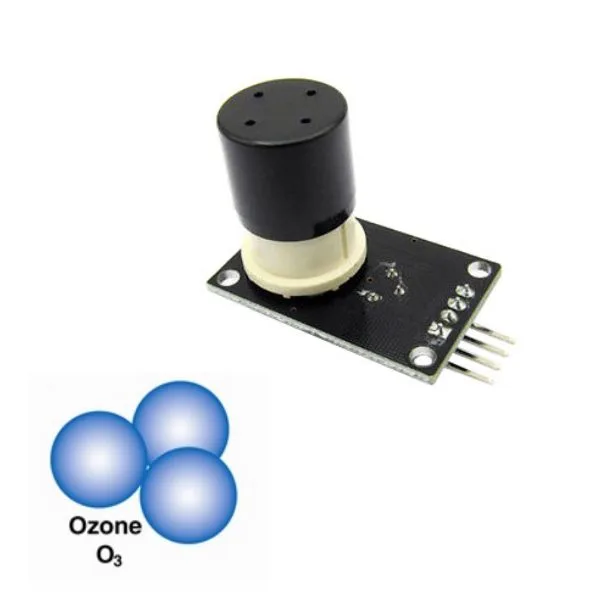
SKU 8300-YM315EAN 8219671099776Item type: AssembledSensors, Sensors
Description
Compact board based on the MQ-131 sensor. Featuring high sensitivity and a very fast response time, this sensor can detect the concentration of ozone (10~1000ppb) in the air. The sensitive material of the sensor is tin dioxide (SnO2), which has low conductivity when the air is clean, and higher conductivity in the presence of ozone.
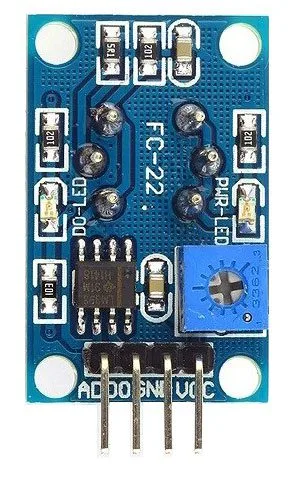
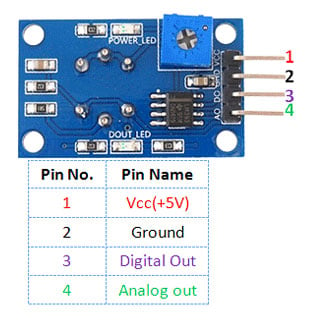
The board features a trimmer to set the threshold value, analog and digital (TTL) outputs, and status LEDs for power and output signal.
The digital output can be connected directly to a microcontroller. The analog output provides a voltage (0-5 VDC) that increases with the concentration of ozone in the air.
Power supply: 5 VDC, dimensions (mm): 31.85×19.65×33. Can be used with Arduino or other microcontrollers.
Ozone
Ozone (chemical formula: O3) is an allotropic form of oxygen, with a characteristic pungent odor. Its molecules are made up of three oxygen atoms.
It is an unstable gas (gaseous at 20 °C, with a half-life of three days, and 20 minutes in aqueous solution), and in liquid state it is explosive. It therefore cannot be stored and must be produced at the time of use.
It has a characteristic pungent odor – the same that sometimes accompanies thunderstorms, due to the ozone produced by lightning discharges; its name derives from the Greek verb ὄζειν, “to smell” – and is strongly irritating to mucous membranes.
It is a powerful oxidant and is highly toxic to living beings. However, it is an essential gas for life on Earth because of its ability to absorb ultraviolet light; the ozone layer in the stratosphere protects the Earth from the harmful effects of UV-C rays from the Sun. It is precisely because of their ability to destroy the stratospheric ozone layer that freons have been banned from production and use. The use of CFCs (which have not been completely abolished) has also greatly decreased.

Image of the ozone layer surrounding the earth, note the deep thinning over Antarctica (2001).
Technical specifications
- Status LEDs for power and output signal
- Analog and digital outputs:
– analog output (0-5 VDC): voltage increases with ozone concentration in the air
– digital output: TTL (0-5 VDC): to obtain a threshold value, set via the trimmer, to manage it with a microcontroller - Stable and reliable
- Very fast response time
- Four mounting holes
- The sensor can be removed from its socket
- Can be used to create devices that detect ozone in home and atmospheric environments
Documentation and useful links
Technical details
| Power supply | 5 VDC |
|---|---|
| dimensions (mm) | 31.85x19.65x33 |
| Ozone sensor | MQ-131 |
| Sensor type | semiconductor |
| Ozone detection range | 10~1000ppb |
You may also like…
-
 Arduino
Related products
-
 Sensors
 -
 Sensors
 -
 Sensors
 -
 Sensors
 -
 Sensors
 -
 Sensors
 -
 Sensors
 -
 Sensors