
RFID transponder reader with relay output
SKU 7100-FT829KEAN 8219671022804Item type: Assembled, KitAccess control
Description
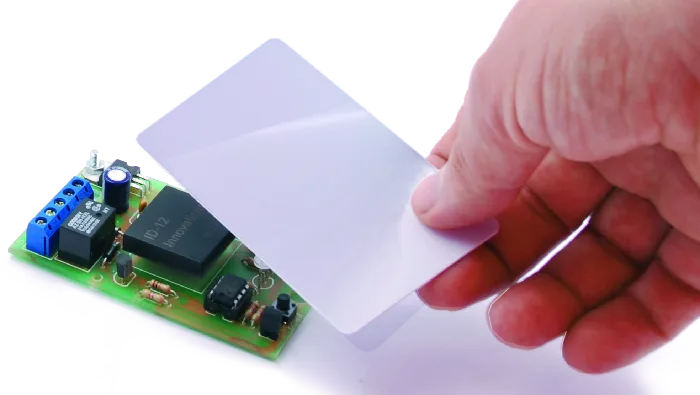
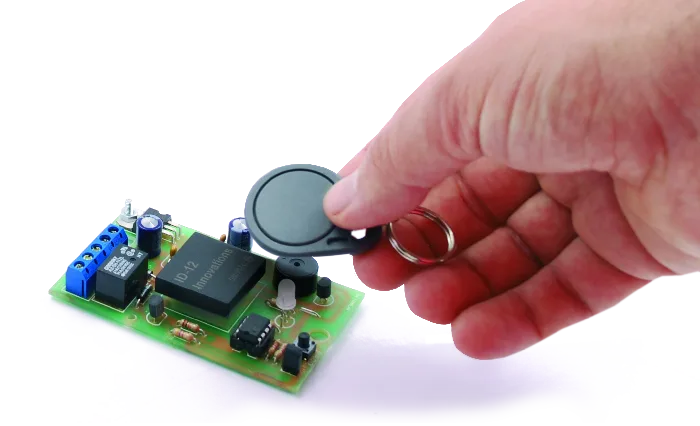
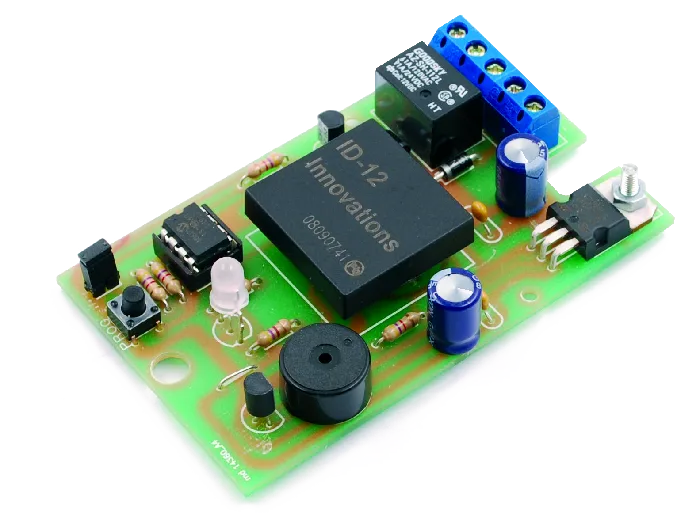
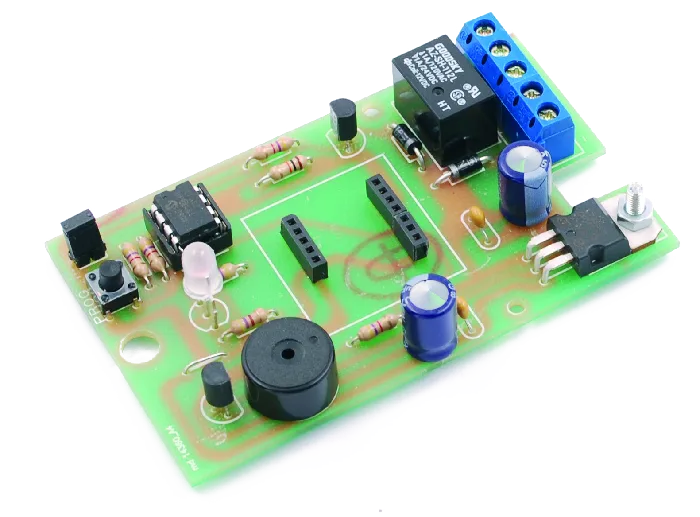
Based on the ID12 module from ID Innovations, this transponder reader features a relay output that activates when one of the 127 storable RFID tags is recognized, allowing you to control an electric lock, a gate opener control unit, a simple lamp, and more. It can store up to 127 tags, has a monostable output (activation for 1 second) or bistable output, and a buzzer that signals when a tag passes over the reader. The SC-700 plastic enclosure is included in the kit.
Warning! Only the tags in the related products (TAG1, TAG2, and TAG3CAPSULA) are compatible with this product.

Technical Specifications
- Up to 127 storable tags.
- Ability to store, delete a single tag, and erase the entire memory.
- Dynamic memory organization: each tag is stored in the first available location.
- Monostable output operation (activation for 1 second) or bistable.
- Buzzer signaling tag passage over the reader.
- Power supply from 11 to 15 Vdc – 150 mA
- Dimensions 83.22 mm x 50.10 mm
Tag Management and Their Uses
During reading, the ID-12 module returns the hexadecimal code in ASCII format, such as A1234B567C (10 bytes) of the transponder card. Only the last 4 characters of this code are considered and stored by the microcontroller in its EEPROM. Considering the example above, 0x56 will be stored in one location and 0x7C in the next, occupying only 2 bytes. The preceding part of the code is ignored because essentially only the last identifiers of the transponder tend to change. This way, it is hypothetically possible to find a tag with the same code no sooner than after 65,535 other tags.
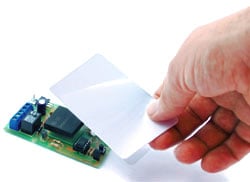
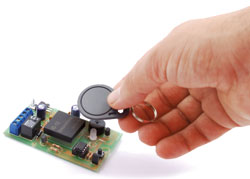
RFID tags are increasingly used in all those applications where it is necessary to identify an object by a code or control access; in logistics, they allow the detection of various items passing, for example, on a conveyor belt, while in supermarkets they help prevent theft. They certainly play a major role in regulating access for people and cars, tracking worker attendance, and creating access keys for electronic systems (e.g., computers).
The ID12 Module
This component integrates the generator for the exciting electromagnetic field, the logic for reading absorption and discriminating codes, and even the exciting coil; it therefore solves all the problems of constructing and positioning the coil itself, which in some projects have troubled readers.
But that’s not all: the ID-12 integrates logic that can output data read from transponder tags only if they are encoded according to three standards: ASCII, Wiegand26, and Magnetic ABA Track2. Precisely because it handles transponder recognition on its own, the ID-12 is the ideal device for building many systems, including electronic access gates, passage recorders, goods classifiers and catalogers, etc. All this relieves any computer or microcontroller that must read its data from the tasks of deciphering and discarding: the component reads the transponders and discards data from those that are out of format or read incorrectly, passing only intact strings.
You may also like…
-
 Access control
 -
 Access control
Related products
-
 Access control
 -
 Access control
 -
 Access control
 -
 Access control
 -
 Access control
 -
 Access control
 -
 Access control
 -
 Access control