
TOF (Time Of Flight) Module with VL53L0X Sensor
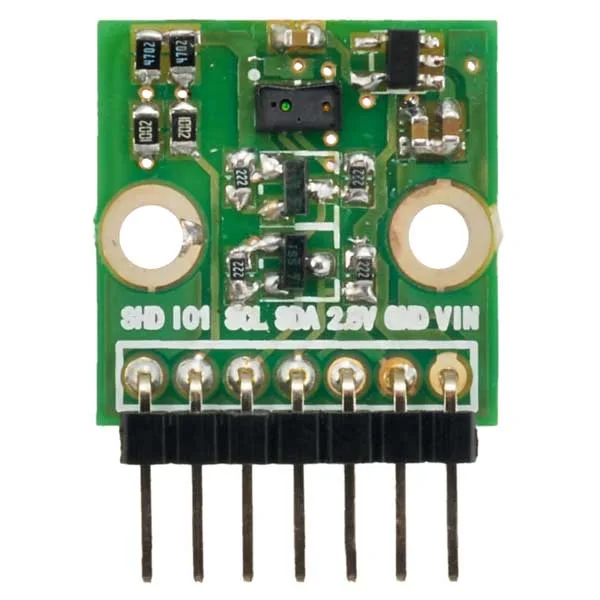
SKU 7100-BREAKOUT018EAN 8219671091282Item type: AssembledSensors, Sensors
Description
|
Breakout board based on Time of Flight technology, carrying the VL53L0X sensor, a low drop-out linear voltage regulator and a MOSFET adapter for the I²C-Bus interface, used to shift the chip’s 0/2.8 V logic levels so that they match the standard TTL levels of conventional logic boards and of Arduino. Communication with the host device, typically a microcontroller, takes place over the I²C-Bus formed by the SCL and SDA pins, clock and bidirectional data channel respectively; through the bus (which runs at 400 kHz) you can set the operating mode, the sensitivity and so on, as well as read the result of the measurement. As for the operating modes, the device can take the measurement at a settable interval or on request, the latter being the mode that keeps consumption down, since most of it comes from switching the laser on. The GPIOs of the VL53L0X can be configured through dedicated commands sent over the I²C-Bus. The VL53L0X is powered through the AVDD (positive) and GND (ground) pins for the receiving section and AVDD_VCSEL and AVSS-VCSEL for the laser diode. The VL53L0X library can be downloaded from our site www.elettronican.it together with the other project files, and also from https://github.com/pololu/vl53l0x-arduino. To use it, once downloaded copy the folder contained in the .zip file into the “libraries” directory where the Arduino environment is installed. The same goes for the library that drives the Neopixel ring. The module gives a microcontroller the distance measured in front of its optical sensor, worked out from the time of flight of a light pulse. Warning: the pin strip connector has to be soldered. |
| What you can build with this Breakout |
|
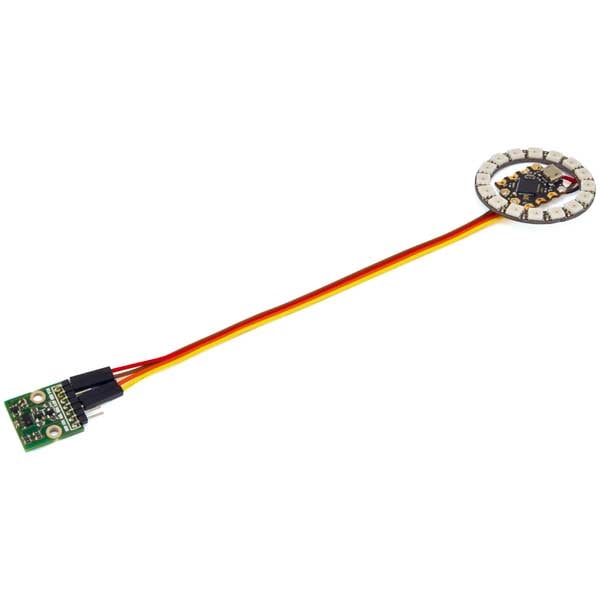
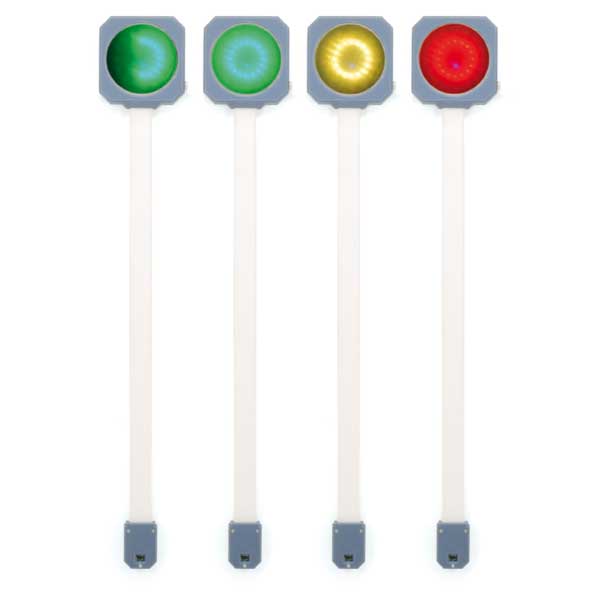
LASER PARKING ASSISTANT: Similar to the parking sensors fitted on cars, except that this one is fixed to the end wall of the parking space. As you approach, the LEDs light up green, then gradually turn yellow, then red and, as soon as the distance drops to the minimum, they flash red to tell you to stop. The system is made up of the breakout with the VL53L0X, interfaced with the Beetle board (which carries a microcontroller), and a Neopixel LED ring that gives the visual feedback, lighting up in the colour matching the measured distance. Please note: the Beetle board with the microcontroller for this project and the Neopixel LED ring are not supplied with the Breakout; to buy them see the related products.
|
| Technical specifications |
|
| The VL53L0X device |
| The ST chip counts the time of flight of the photons that make up the light emitted by a microscopic laser built into it. Compared with similar optical solutions, and especially with those using IR emitting LEDs and IR photodiodes, the VL53L0X does not suffer from the light being absorbed by the surface to be detected. This comes from the way it works: it does not read the intensity of the reflected light, it works out the time elapsed between the emission of the IR light by the VCSEL laser and its reception by the photodiode. On top of that, the ST device carries a second light sensor, which measures the ambient brightness so that it can be subtracted from the light reaching the photodiode as a result of the laser light reflected by the obstacle to be detected. Having a second sensor is also ideal for applications of the chip as a proximity sensor in tablets and smartphones, where placing the component behind the touch-screen glass produces reflections and refractions that send part of the light emitted by the laser back onto the photodiode far too early, which would falsify the measurement. This is how the ambient light sensor works. Another feature that makes the circuit insensitive to the absorbance of the surface whose distance is being measured is a special circuit design that allows the gain of the receiving stage and the ambient light to be adjusted and very short pulses to be emitted. The technique used to measure the time of flight of the light pulse is also based on a Photon Avalanche Diode (SPAD) photodetector, which goes from a reverse-bias state close to the breakdown voltage to reverse avalanche conduction when a photon of the light striking the sensitive surface arrives.
Like its predecessor, the VL53L0X is used in: • proximity sensors for smartphones, autofocus systems for smartphones and cameras, gesture recognition for browsing content on mobile devices; |
| Breakout boards |
|
Breakout boards are prototyping boards carrying the component of interest already soldered, with its connections brought out on the edge of the board on pads that are easy to use in terms of pitch and termination; the connections are generally pads on a 2.54 mm pitch, like those of the classic DIP chips. To help those who would like to use SMD parts but have neither the tools nor the skill to solder them, a number of chips have been selected (sensors, switching power supplies, battery chargers, linear amplifiers and so on) and mounted on ready-to-use boards. These breakout boards are both a help for anyone who wants the best of SMD electronics ready to go in a “traditional” format, and for anyone who — even though able to work with SMD parts — needs those parts available on prototyping boards so as to add them to existing circuits and run tests, or to build prototypes that include the functions of those chips before making the final printed circuit board of a piece of equipment. |
| Documentation and useful links |
Technical details
| Supply voltage | 5 Vcc |
|---|---|
| Current draw | 400 mA |
| Measurable distance | 2 m |
| Laser and sensor wavelength | 940 nm |
| The chip is tiny | it measures just 4.40x2.40x1 mm |
Related products
-
 Sensors
 -
 Sensors
 -
 Sensors
 -
 Sensors
 -
 Sensors
 -
 Sensors
 -
 Sensors
 -
 Sensors