
24-Relay 16 A Ethernet Board with 8 I/O Channels and Snubbers
SKU 7626-DS2824SNUBBEREAN 8219671116206Item type: AssembledEthernet devices
Description
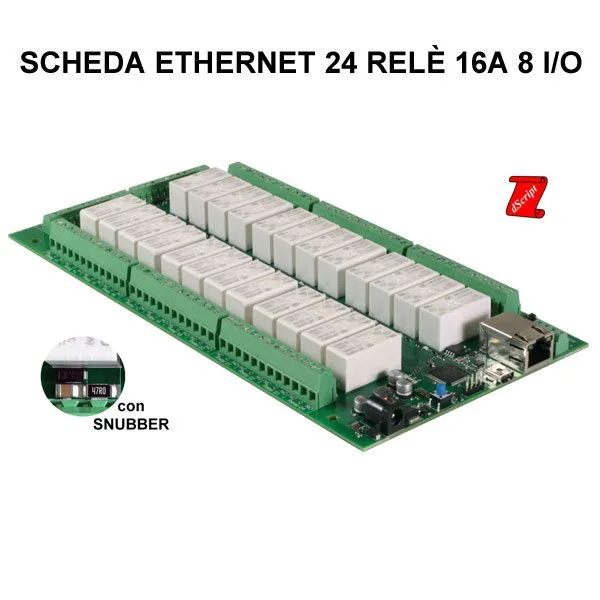
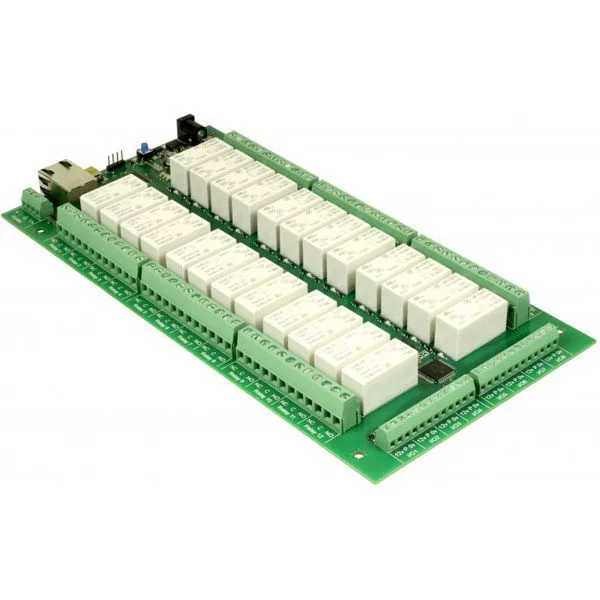
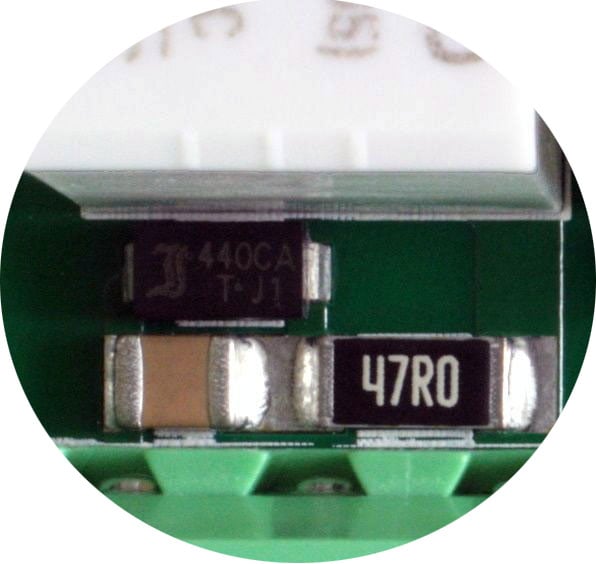
| Ethernet-interfaced board with 24 relay outputs, N.O. and N.C. contacts (24 Vdc or 250 Vac / 16 A), each with its own snubber (suppressor) and status LED, 8 I/O channels, plus Ethernet and power status LEDs.
It can be controlled over a LAN (Local Area Network), from a smartphone or through the Internet. With Devantech’s powerful dScript language you can add your own functions and controls to the modules that support it, build a custom web page, add your own logo, buttons and features, add a TCP server, answer incoming TCP requests with your own routines, include a TCP client and send TCP data packets to other devices using your own protocol. Power supply: 12 Vdc-500 mA (not included, see related products), dimensions (mm): 250x123x20. The board is supplied ready assembled and tested. |
| Features |
|
| Some videos of the various uses |
| Snubber |
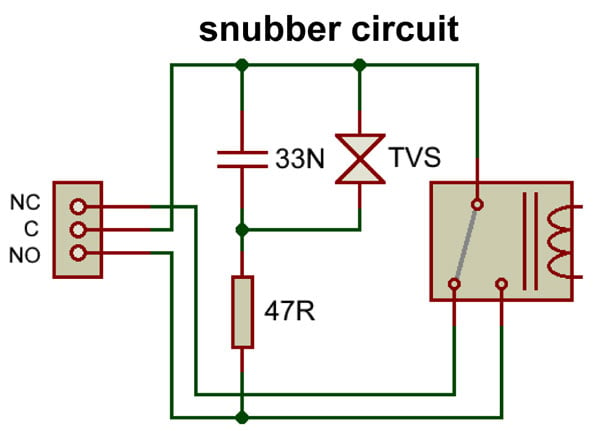
| Why might you need RC suppressors on the relay outputs? Inductive loads generate voltage spikes when they are switched, and adding an RC suppressor absorbs the energy released as the device turns off, extending the life of the relay because it stops the arc that forms at switch-off.
Examples of inductive loads that need an RC suppressor:
|
| Why don’t all relay outputs simply have snubbers on them?
RC snubbers are not ideal for every application, because they leak a small amount of AC current, and that is no good for audio signals, for instance. A small AC current flowing in the load can mean power still gets through even when the relay is off. Snubbers should really only be used where the load is inductive. |
|
|
Technical specifications
|
|
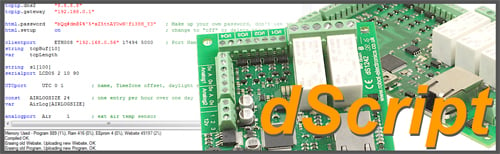
| dScript – a programming language for the IoT (Internet of Things) |
|
|
| dScript, derived from Devantech’s scripting language, is a multi-threaded language for connecting Devantech relay modules that support it to the Internet. It compiles the source code into a form the module’s on-board firmware can interpret. dScript is an editor, a compiler and a programmer for every dScript-enabled module. dScript is not BASIC, but the syntax will look familiar to anyone who has used Visual Basic or small chips programmable in Basic.
Multi-threading Web server Safe and secure |
|
Documentation and useful links
|
Technical details
| Power supply | 12 Vdc-500 mA (not included, see related products) |
|---|---|
| dimensions (mm) | 250x123x20 |
| Serial ports | 1 TTL-level serial port, 1 RS485 port |
| I/O | 8 channels, VFC input, NPN output, 12-bit analogue input |
| Communication interface | USB for development, RJ45 Ethernet for normal access |
| dScript editor requirements | requires Windows 10 or later, Linux or macOS |
| Weight | 550 g |
Related products
-
 Ethernet devices
 -
 Ethernet devices
 -
 Ethernet devices
 -
 Ethernet & Wi-Fi
 -
 Ethernet & Wi-Fi
 -
 Ethernet & Wi-Fi
Ethernet Board, 2 Relays 16 A, 4 Digital I/O and 2 Analog Inputs
€56.48excl. VAT€68.90incl. VAT -
 Ethernet devices
 -
 Ethernet devices