
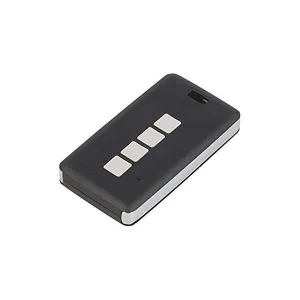
LoRa radio remote control (433 MHz) – assembled
SKU 7100-FT1250MEAN 8219671085403Item type: AssembledLoRa modules, RF transmitters
Description
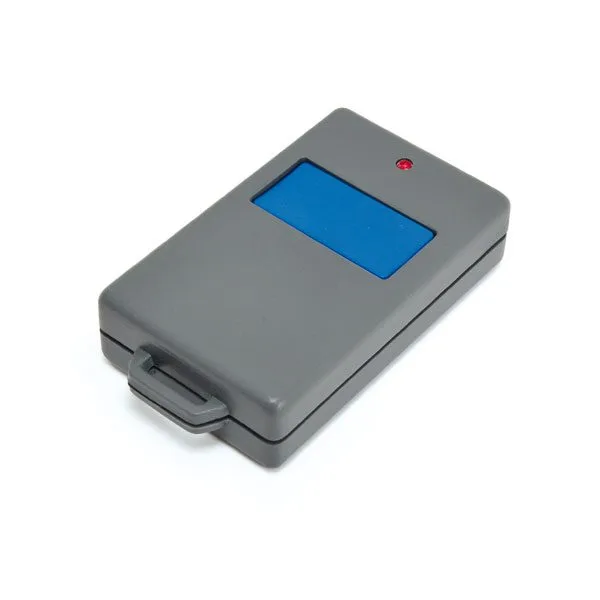
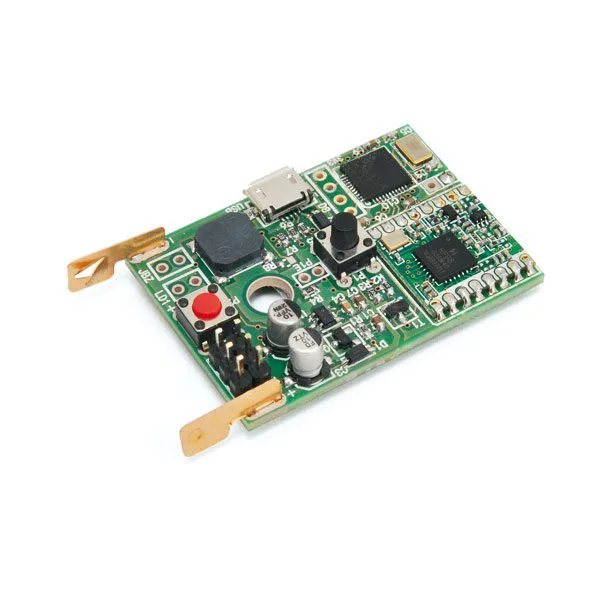
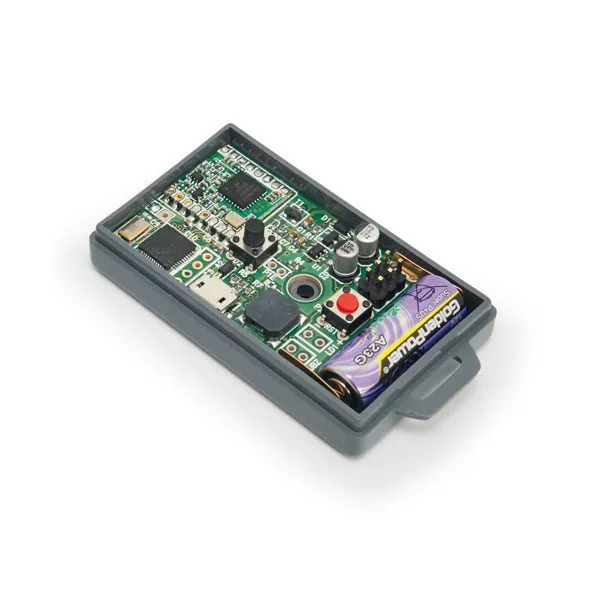
| Handheld transmitter built around the SX1278 LoRa radio module (433 MHz) and driven by an ATmega32u4 microcontroller. Meant to be used together with the LoRa shield (see related products), it lets you build long-range radio controls. A micro USB socket is provided for programming through the Arduino IDE. The transmitter runs on a 12V A23 battery and draws about 20 mA on average while active. The remote control is supplied assembled, tested and complete with its enclosure. |
 |
| Alternative uses for the remote control hardware |
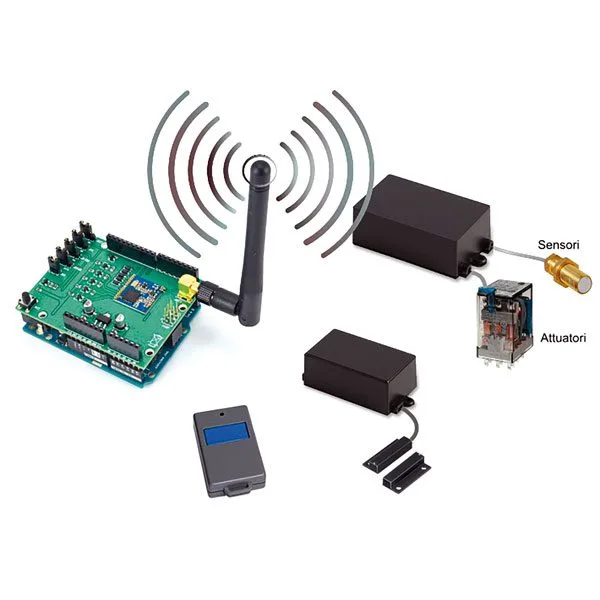
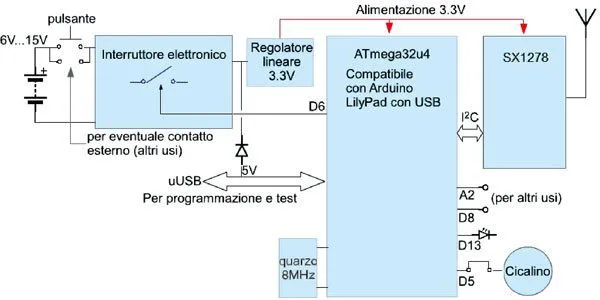
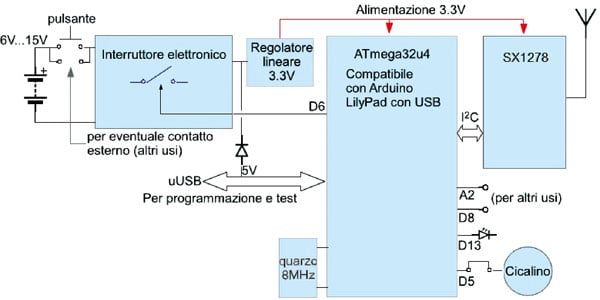
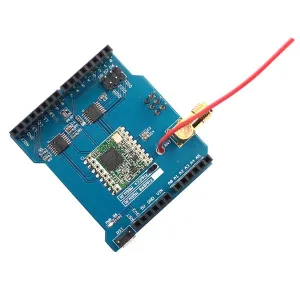
| If we wire a voltage-free contact in parallel with the pushbutton, for instance one of the reed contacts made for doors and windows (the burglar alarm type, ed.), we end up with an effective wireless intrusion alarm sensor. Fit one to a door, for example, and the server, even a long way away, will receive notice that the door has been opened, which can be used either as an alarm or as an event log entry. Remember that the LoRa shield can be mounted on RandA (our Raspberry Pi shield that carries the Arduino UNO core), where the Raspberry Pi processor can act as a sophisticated server, connected to the Internet if required. Because the remote control is small and carries its own power source, it can be placed wherever a mechanically triggered sensor is needed. Add a small circuit acting as an ultra-low-consumption timer (a few nanoamps) and the pushbutton can be operated electronically, for example through a MOS transistor working as a switch. The unit could then periodically send the server an analogue value read on pin A2 or a digital value on pin D8. For this alternative use an enclosure of comparable size to the remote control one could be chosen, such as the G1013 (with some adaptation), if the pushbutton window is not wanted. These alternative uses of the remote control all rely on the circuit being switched on only momentarily, as it is powered by a small non-rechargeable battery. A further development of the remote control circuit is, however, already being studied. This new small board, not far in size from the remote control one, will add a charger for 3.7 V LiPo batteries. The result will be a board complete with processor and radio module, able to power itself and to stay on permanently.
In short, a family of three types of device is planned: |
| Documentation and useful links |
Technical details
| Supply voltage | 12 Vdc |
|---|---|
| Current draw | 20 mA |
| Maximum range | 500 m |
| Dimensions (mm) | 61x37x15 |
You may also like…
-
 Arduino
Related products
-
 RF transmitters
 -
 LoRa modules
 -
 RF transmitters
 -
 LoRa modules
 -
 LoRa modules
 -
 RF transmitters
 -
 RF transmitters
 -
 LoRa modules