
Programmable Tibbo BASIC/C IoT Module
SKU 8100-EM2000EAN 8219671109468Item type: AssembledEthernet devices
Description
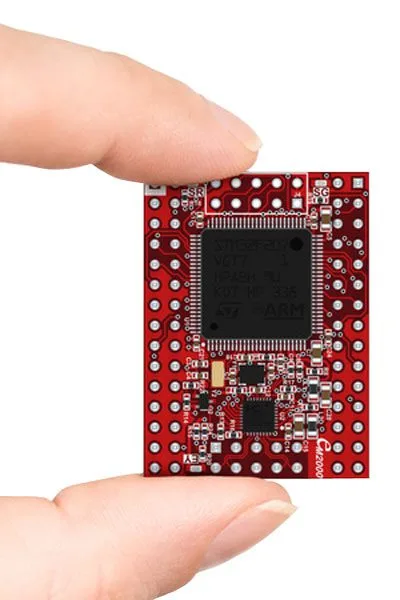
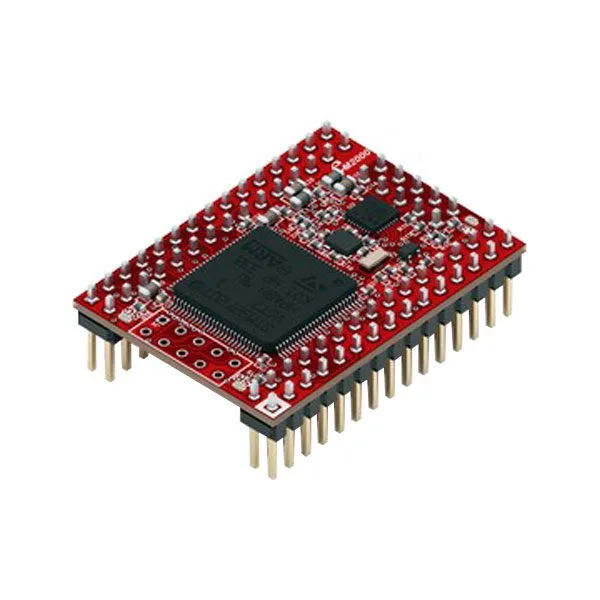
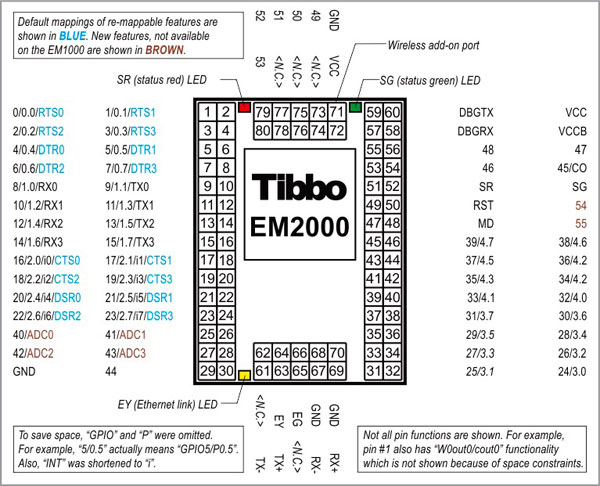
The EM2000 is a programmable IoT Tibbo BASIC/C module and represents the evolution of the previous model, the EM1000. It supports Wi-Fi and Bluetooth BLE connectivity through the WA2000 and GA1000 modules (not included – see related products) and can control a GPRS modem (such as SIM900 – not included). It features 1MB of Flash memory for TiOS and application code + 1MB for the file system, four high-speed serial ports (CMOS level), four synchronous serial ports with SPI and I2C modes, RTC (backup power connected externally), three status LEDs, four control lines for external status LEDs, 56 general-purpose I/O lines, and can control an external LCD, keyboard, buzzer, card readers, serial devices, and other circuits. All I/O lines are accessible via two dual-row connectors with a standard 2.54mm (100mil) pitch. Firmware updates for TiOS and compilation of Tibbo BASIC/C apps over the air are possible (requires the WA2000 module and an iOS or Android device). Power: 3.3 VDC – 100 mA; dimensions (mm): 38.4×28.4×5.5.
Advantages of the EM2000 over the EM1000 module
- 32-bit architecture (compared to the 16-bit architecture of the EM1000)
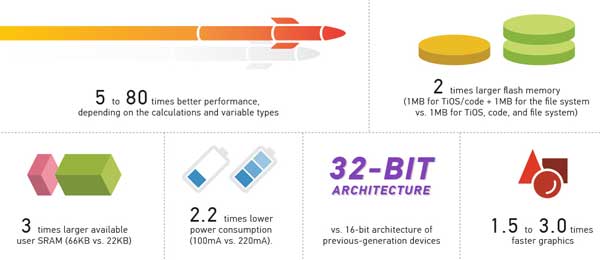
- 5 to 80 times better performance, depending on calculations and variable types
- GPIO manipulation 7 times faster
- SRAM 3 times larger (66 KB vs 22 KB)
- 2.2 times lower power consumption (100 mA vs. 220 mA)
- Graphics up to 3 times faster
- Flash memory 2 times larger (1 MB for TiOS / code + 1 MB for the file system vs. 1 MB total for TiOS, code, and file system on the EM1000)
- 56 I/O lines (vs. 54 lines on the EM1000)
- 4-channel ADC
- Ability to update TiOS firmware and compile Tibbo BASIC / C apps over the air (requires the WA2000 module and an iOS or Android device)
Technical features
- High-performance ARM CPU
- 10/100 Base-T Ethernet port (no RJ45/magnetics)
- Optional Wi-Fi connectivity (with add-on components WA2000 and GA1000)
- Optional BLE (Bluetooth Low Energy) connectivity (with add-on component WA2000)
- Optional GPRS connectivity (requires an external modem)
- 4 UARTs support serial, Wiegand, and clock/data streams
- 56 general-purpose I/O lines (5V-tolerant)
- Can drive an externally connected buzzer
- 4 ADC channels
- 4 synchronous serial ports with SPI and I2C modes
- Supports an externally connected TFT LCD display
- Supports externally connected matrix keyboards
- Onboard RTC (backup power connected externally)
- 1MB of Flash memory for TiOS and application code + 1MB for the file system
- 2048-byte EEPROM
- 3.3V power
- 2.54mm (100mil) pin pitch suitable for prototyping
- Supports over-the-air (OTA) firmware updates (with add-on component WA2000)
Technical specifications
- 32-bit architecture
- Powered by Tibbo OS (TiOS)
- 10/100BaseT auto-MDIX Ethernet port with RJ45 connector
- Optional Wi-Fi interface (requires add-on modules WA2000 or GA1000 – not included – see related products)
- Optional BLE interface (requires add-on module WA2000 – not included – see related products)
- Can control a GPRS modem (such as SIM900 – not included)
- Four high-speed serial ports (CMOS level):
– Baud rates up to 460,800 bps
– None/even/odd/mark/space parity modes
– 7/8 bit / character modes;
– Full-duplex mode with RTS/CTS and XON/XOFF flow control
– Half-duplex mode with direction control
– Encoding and decoding of Wiegand and clock/data streams - Up to 56 lines configurable as input or output (8 as interrupts)
- Programmable square wave output for external buzzer
- 4 ADC channels
- 4 synchronous serial ports with SPI and I2C modes
- Supports external LCD (320×240) and keyboard
- RTC (Real Time Clock) with dedicated backup power input
- 66 KB SRAM for Tibbo BASIC / C variables and data
- 1MB of flash memory that can be partitioned between firmware, application, and data
- 2048 bytes of memory for data storage
- Three status LEDs
- Four control lines for external status LEDs:
– Two control lines for main green and red status LEDs
– Two control lines for Ethernet “link” and “100MB” LEDs - Software-controlled PLL allows selecting speed (full, medium, low)
- Firmware can be updated via:
– serial port
– LAN
– Over-the-air (requires WA2000 and an iOS or Android device). - CE and FCC certified
Documentation and useful links
Technical details
| Power | 3.3 VDC – 100 mA |
|---|---|
| Dimensions (mm) | 38.4x28.4x5.5 |
| Pin pitch | 2.54 mm |
| Operating temperature | from -40°C to +80°C |
Related products
-
 Ethernet devices
 -
 Ethernet devices
 -
 Ethernet devices
 -
 Ethernet & Wi-Fi
 -
 Ethernet & Wi-Fi
 -
 Ethernet & Wi-Fi
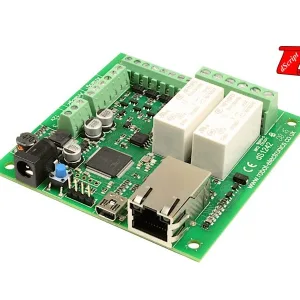
Ethernet Board, 2 Relays 16 A, 4 Digital I/O and 2 Analog Inputs
€56.48excl. VAT€68.90incl. VAT -
 Ethernet devices
 -
 Ethernet devices