
Robotic Arm for Micro:bit
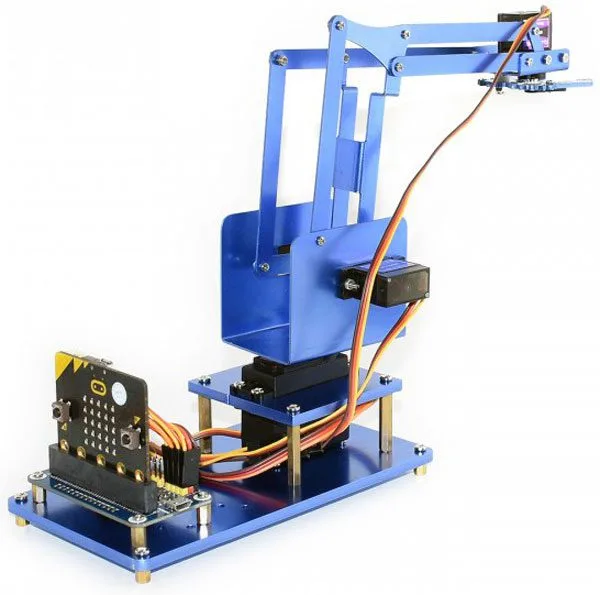
SKU 2850-MICROBITARMEAN 8219671108041Item type: Kit, Robotics & gamingmicro:bit
Description
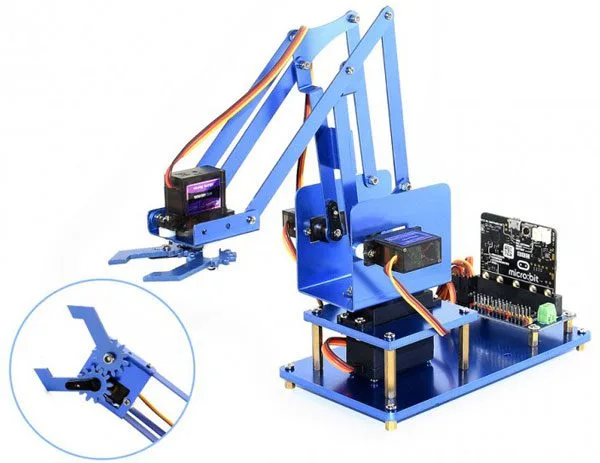
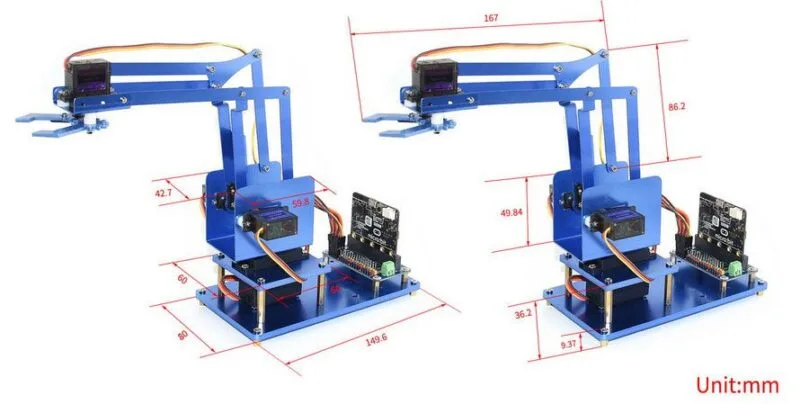
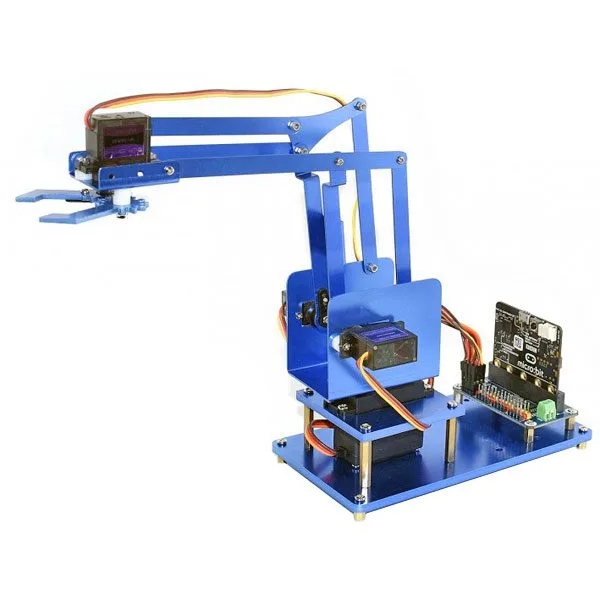
Kit containing everything needed to build a robotic arm in aluminum alloy with 4 degrees of freedom and a gripper for grabbing objects, all managed via the micro:bit board (not included). Once the micro:bit board is programmed, the robotic arm can also be controlled via Bluetooth connection through a simple smartphone app.
The electronic board has a connector for inserting the micro:bit, a driver based on the PCA9685 chip that allows managing up to 16 RC servos or LEDs simultaneously, I²C interface, and a 5-volt voltage regulator capable of supplying 3 A of current. The 16 output ports have a 12-bit resolution, each with 3 pins: V+, GND, and PWM output. Each PWM works completely independently, but all must have the same PWM frequency.
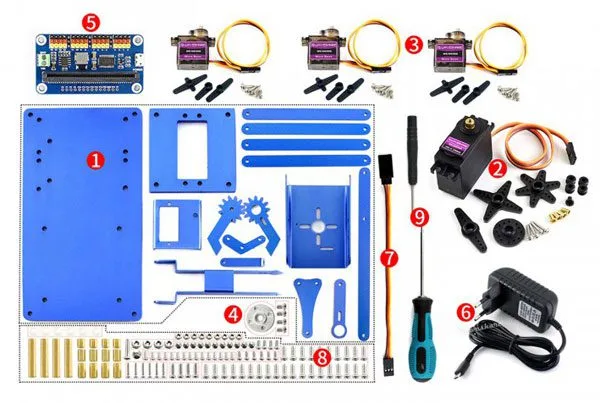
The package includes: 1 analog RC servo (MG996R) with metal gears, 13 kg•cm torque, and accessories, 3 analog mini RC servos (MG90S) with metal gears, 2.5 kg•cm torque, and accessories, 1 electronic board, 1 mains power supply with micro USB output (5 V, 3 A), 1 RC servo extension cable (150 mm), 2 screwdrivers, aluminum alloy parts for the robotic arm, and all the necessary mechanical hardware for assembly.
Programming Environments





- MICROSOFT PXT (BETA) is a programming environment created by Microsoft (still in beta) that supports both a block-based graphical environment, in Scratch style, and the JavaScript language.
- PYTHON has been and is still being developed to allow programming microcontrollers in a Python-compatible language. The opportunity to use the Python language allows continuity, in a hypothetical educational path, towards the use of more complex systems such as microcomputers capable of hosting GNU/Linux, like the Raspberry Pi series.
- MICROSOFT BLOCK EDITOR is a visual editor very similar to Scratch and represents the starting point for those who want to start programming. Like Scratch, it is very simple to use but it is not a toy. It allows you to deepen structured programming and event management. The method of composing a program consists of choosing the blocks that represent the instructions, dragging them into the editor panel, configuring them in the customizable parts, and “fitting” them together correctly.
- MICROSOFT TOUCH DEVELOP was developed to create programs for the micro:bit using tablets or other devices with touch screens. Obviously, it can also be used from normal PCs using keyboard and mouse.
- JAVASCRIPT is a development environment that allows those who have made progress in programming to develop programs using the textual syntax of JavaScript, with a guided editor that supports the “click and drag” method for composing lines and blocks of code.
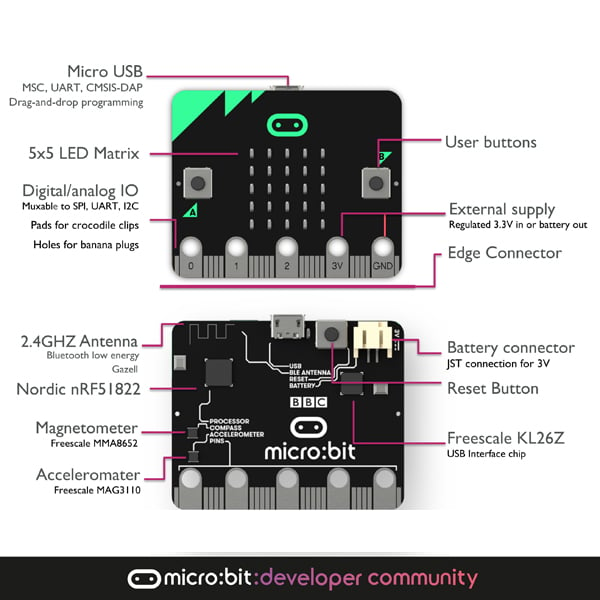
Technical Specifications of micro:bit
- 25 red LEDs that can be turned on with different intensities to create drawings, animations, and games.
- Two buttons that can be managed via software to customize its behavior.
- A reset and restart button.
- An accelerometer capable of detecting and recognizing different types of movement such as shaking, rotations, and free fall. Useful for creating a motion sensor or animated games.
- An electronic compass capable of detecting orientation and rotation in degrees relative to North. A further use could be as a metal (magnetic) detector.
- A USB connector to connect the micro:bit to the PC to upload software programs.
- A connector for external power supply.
- A Bluetooth Smart Technology module that allows connecting the micro:bit with other devices equipped with the same technology such as other micro:bits, PCs, smartphones, Bluetooth kits, tablets, and cameras.
- A temperature sensor capable of detecting ambient temperature.
- A connector with 24 pins, five of which have pads suitable for connecting with crocodile clips. On the connector, analog and digital I/O, communication buses, and other functionalities described in more detail later are available.
Documentation and Useful Links
Technical details
| all managed via the micro | bit board (not included) |
|---|---|
| Technical Specifications of micro | bit |
You may also like…
-
 micro:bit
Related products
-
 micro:bit
 -
 micro:bit
 -
 micro:bit
 -
 micro:bit
 -
 micro:bit
 -
 micro:bit
 -
 micro:bit
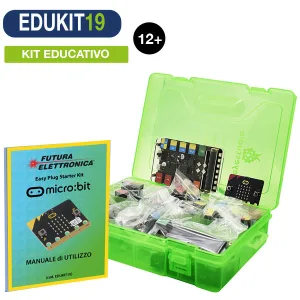
STEM – Easy Plug Kit with micro:bit, Sensors and Italian Guide
€108.20excl. VAT€132.00incl. VAT -
 micro:bit