
5W Wireless Power Receiver Board
SKU 7100-FT1236MEAN 8219671079068Output voltage: 5 VdcItem type: AssembledDC/DC converters
Description
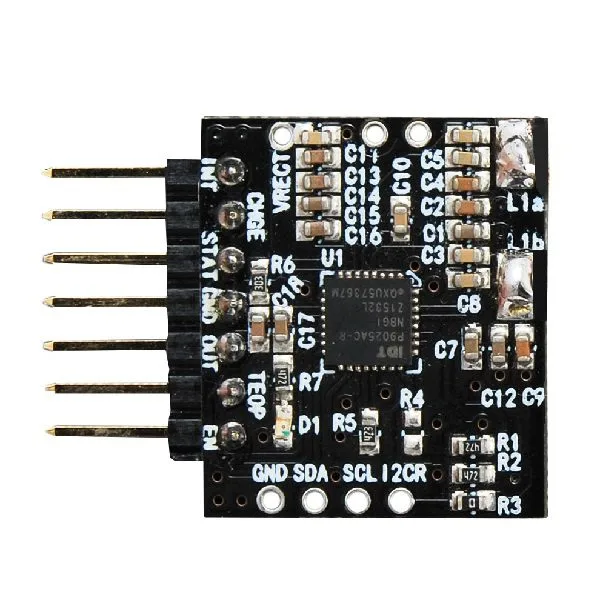
Receiver board for 5W Wireless Power.
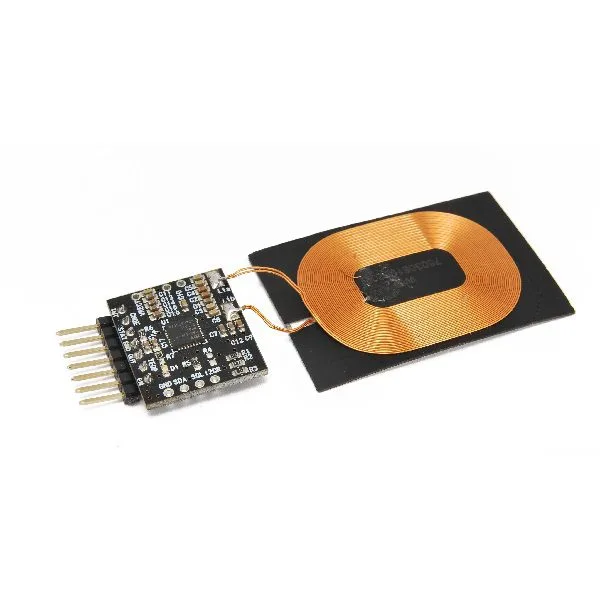
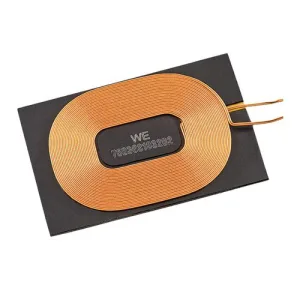
Receiver module that, combined with a transmitter unit 7100-FT1235M, allows you to create wireless power transfer systems. The receiver unit, based on the P9025AC IC from IDT, receives the voltage induced across the receiver coil (code 760308103202), rectifies it to obtain the current needed for both the board itself and the load, providing voltage across the Vrec and GND terminals. The receiver module is equipped with a 7-terminal strip with 2.54 mm pitch.
Ideal for use with Arduino, small robots, locators, and more generally for all those systems where it is necessary to transfer energy without contact.
Dimensions: 24 x 21 mm
Note: The board is supplied already assembled. The coil for the Wireless Power receiver is not included and can be purchased separately.
Documentation
The Technology
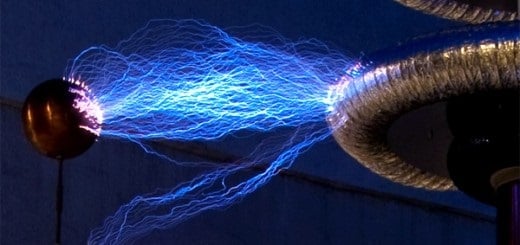
The possibility of transferring electrical energy through electromagnetic waves was first demonstrated in 1890 by Nikola Tesla, who perhaps did not imagine how much it would be appreciated today. The technique is easy, but making this technology more efficient, less bulky, especially for higher powers than the negligible ones available in the past, is the real challenge, which becomes more difficult if solutions must be economical and miniaturized to be introduced even in the smallest devices. IDT (Integrated Device Technology), a California company pioneering this technology, has made available documentation and products to create miniaturized systems to integrate into the many fields of wireless battery charging.
The Qi Standard
To ensure compatibility between transmitters and receivers, the Wireless Power Consortium (WPC) was created, which established a standard (Qi) ad hoc; this consortium was founded in 2008 and consists of Asian, European, and American companies. The WPC defines the type of inductive coupling, intended as the configuration of the inductances, and the communication protocol to be used; in this way, any device that meets the WPC standard specifications can operate with another standard product even of a different brand, ensuring interoperability and, above all, the availability of power when away from home. The inductances allow, in addition to energy transfer, also the communication channel between receiver and transmitter. The standard defines systems capable of transferring energy without contact, typically with powers up to 5W and distances not exceeding 5mm; the output voltage regulation is achieved through digital control that allows using the communications exchanged between RX and TX to inform the latter of the amount of power required by the load.
You may also like…
-
 DC/DC converters
 -
 Relays & coils
Related products
-
 DC/DC converters
 -
 DC/DC converters
 -
 DC/DC converters
 -
 DC/DC converters
 -
 DC/DC converters
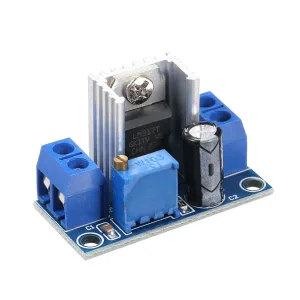
DC/DC Module with LM317 Voltage Regulator – Adjustable Output 1.2-37V
€2.30excl. VAT€2.80incl. VAT -
 DC/DC converters
 -
 DC/DC converters
 -
 DC/DC converters