
UV-C sensor breakout board
SKU 7100-FT1600MEAN 8219671085373Item type: AssembledSensors, Sensors
Description
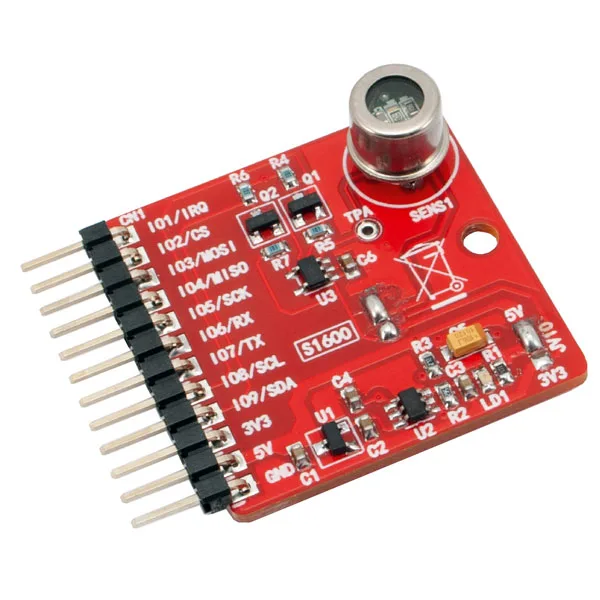
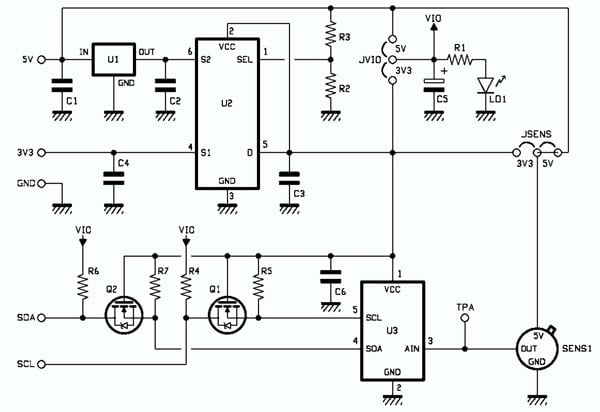
| Based on the GENUV GUVC-T21GH sensor (http://www.geni-uv.com), this breakout board reads UV-C radiation and provides analogue information over the I²C Bus on the radiation intensity. Two jumpers are fitted: the first sets the communication level (3.3V / 5V, provided the external 5V supply is present), the second selects the operating voltage of the UV sensor (factory-set to 5V), since the full-scale voltage of the analogue output depends on it. Dimensions (mm): 33x33x10. |
| UV RAYS: WHICH ONES AND HOW MANY |
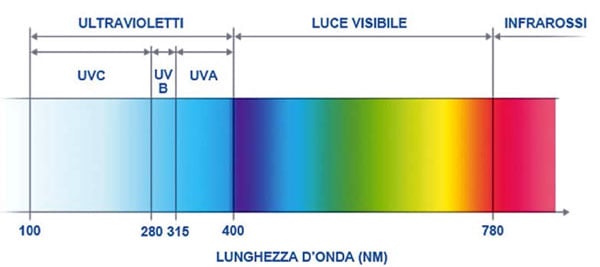
The light spectrum, from visible light out to the far ultraviolet. |
| The ultraviolet part of the spectrum is divided into 3 wavelength bands: UV-A (315÷400 nm), UV-B (280÷315 nm) and UV-C (100÷280 nm). The ultraviolet radiation produced by germicidal lamps (UVGI – Ultraviolet Germicidal Irradiation) falls in the UV-C band, that is between 100 and 280 nanometres. UV-C rays are not tolerated by living beings: a long enough exposure kills the micro-organisms on the objects it strikes, breaking the bonds of DNA and RNA by photochemical reaction, but it also harms the skin and above all the eyes, should the retina be hit. Detecting ultraviolet rays, and UV-C in particular, matters because besides the known sources there can be uncontrolled ones in the environment, produced by light fittings and by the UV-C sterilisers and sanitisers that are now widespread. In general the artificial sources of ultraviolet are discharge lamps, that is neon tubes (where most of it is converted into visible wavelengths and a small part escapes), but also tanning lamps and, more recently, particular LEDs now used in the most modern sanitisers. Whether lamps or LEDs, when handling devices that emit UV-C light one must bear in mind that they are harmful to people too, so the greatest care is needed when using UV-C emitters and one should avoid looking towards them. Less dangerous are UV-A rays (emitted by indoor tanning lamps and machines – sunbeds, for example…) and UV-B rays, since their wavelengths are longer and the energy given up by radiation is inversely proportional to its wavelength, so they transfer less energy. |
| Circuit diagram |
 |
| Let’s try it with Arduino |
| To try out the board with the ever-present Arduino we wrote a sketch based on the MCP3221 library, which takes care of setting up and talking to the on-board ADC; once the I/O lines have been initialised and declared, the converted value is printed on the serial port (with a SerialPrint) both as a voltage and as a “mW/cm2” figure, worked out from the formula given in the datasheet, which is as follows: UVCPower = Vout / 0.71 This formula applies to an ultraviolet source at 254 nanometres; with different wavelengths it may change. In practice the UV irradiance can be derived from the voltage supplied by the sensor and converted by the A/D converter on the breakout board. The code used to test the sensor is given below. |
|
#include “MCP3221.h” serial is open ”)); |
You may also like…
-
 Fishino
Fishino UNO Rev.2 – Board Based on the Arduino UNO ATmega328
€35.98excl. VAT€43.90incl. VAT -
 Arduino
 -
 Arduino compatible
Related products
-
 Sensors
 -
 Sensors
 -
 Sensors
 -
 Sensors
 -
 Sensors
 -
 Sensors
 -
 Sensors
 -
 Sensors