
BLEBRICK LASER ToF sensor
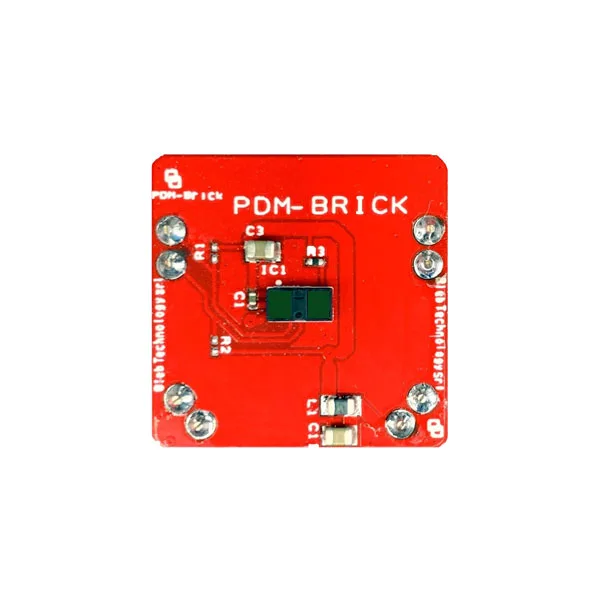
SKU 7300-BLEBPDMItem type: Assembled, Shields & add-onsBlebricks
Description
| The Blebrick PDM is a LASER Time-of-Flight (ToF) sensor that gives accurate, fast and frequent readings. It measures distance, detects presence and monitors flows of people. The user can set the sampling interval and configure the operating mode of the sensor. | |
| The PDM sensor has two configurable operating modes: – Ranging mode: the PDM measures the distance between itself and people or objects. There are 3 different distance modes (long, medium and short range) to choose from, trading maximum measurable distance against immunity to ambient light. – Crossings counter mode: the PDM watches an area continuously (a house or shop doorway, for example) and counts how many times it is crossed by people or objects, and in which direction.In ranging mode the reading is accurate only when no warnings are raised; the usual ones are: – Out of bounds (the sensor is trying to measure too great a distance) – Wrapped target (the target is too small, or its surface is very uneven).Crossings counter mode can also be used for basic gesture detection. Further information: care is needed when using the sensor in the open, and the objects must be of a suitable size. Readings can also be thrown off by reflective walls that interfere with the optical cone of the sensor. Applications: Usage detection, to switch things on and off or open and close applications |
|
| Makeapp | |
|
When the PDM sensor is connected to your BLE-B, the MakeApp shows the distance reading and the status. When the status is anything other than Valid, the accuracy of the reading is low.  Click the sensor icon to switch the measurement mode from long distance to short distance, which gives greater accuracy. |
|
| Technical specifications | |
|
|
| Blebricks: instant prototyping for IoT, smart sensors and RFID | |
The Internet of Things is finally within everyone’s reach.Blebricks are smart bricks built on a patented technology: put them together and you create new electronic devices that communicate wirelessly. The technology lets you build devices without any technical background in electronics or programming. Prototyping is instant, which is why it appeals to anyone who wants to make a device of their own quickly and simply. How? It could not be simplerEach Blebrick does one specific job. There is a wide choice of sensors, actuators, power and communication devices: motion sensors, environmental sensors, CO2 sensors, infrared sensors and air quality sensors, Wi-Fi, Ethernet and LP-WAN communication devices, to name a few. To add the functions you want, just click the Blebricks together. They configure themselves automatically to work as one, and the prototype of your device is ready straight away! You can view the sensor data and interact with it (locally, from your smartphone) using our MakeApp for Android devices. If you would rather build an app of your own, you can do that with MIT App Inventor. Finally, you can work with the Blebricks wherever you happen to be, simply by connecting them to the Internet and logging in to the Bricksboard. With this highly innovative technology you can cut more than 90% of the time and cost of development in going from idea to product. And because they draw very little power, Blebricks also suit battery-powered, portable or wearable devices. The modular nature of Blebricks means a finished product that is cheaper and quicker to make. Find out about our Fast Route To Production. |
|
| Documentation and useful links | |
Technical details
| Minimum measurement interval | 150 ms |
|---|---|
| Emitter | 940 nm invisible laser (Class 1) |
| Measuring range | up to 400 cm |
| Sensitivity | 1 mm |
| Field-of-View (FoV) | 27° |
| Supply voltage | 3V +/- 10% |
| Operating temperature | -40°C to +85°C |
| Dimensions (mm) | 22.5x22.5x5 |
Related products
-
 Blebricks
 -
 Blebricks
 -
 Blebricks
 -
 Blebricks
 -
 Blebricks
 -
 Blebricks
 -
 Blebricks
 -
 Blebricks