
Arduino shield for RC servo control
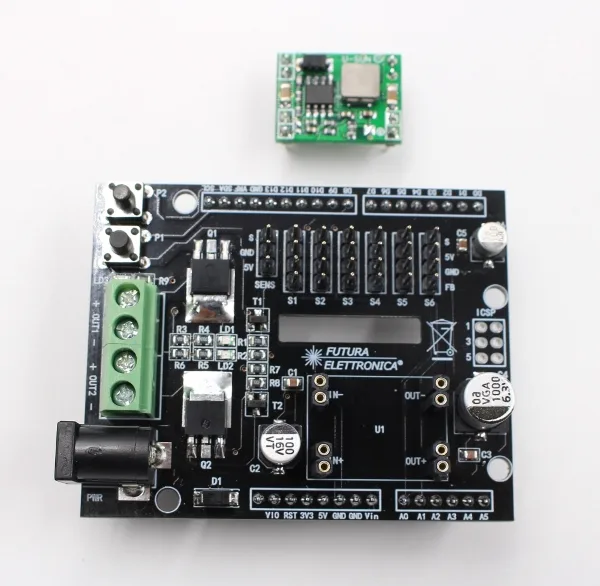
SKU 7100-FT1397MEAN 8219671098533Item type: Assembled, Robotics & gaming, Shields & add-onsArduino, Arduino compatible
Description
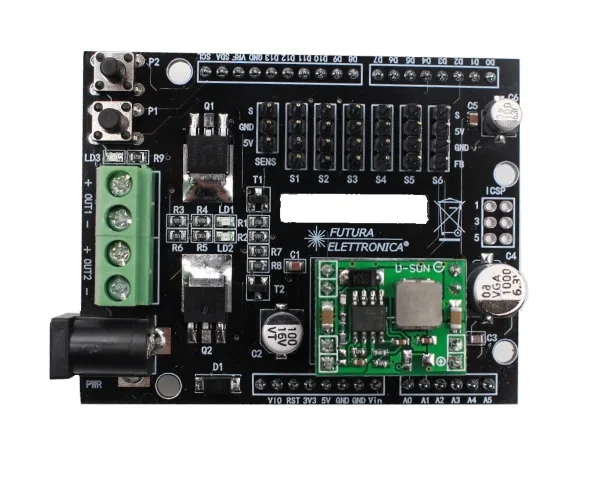
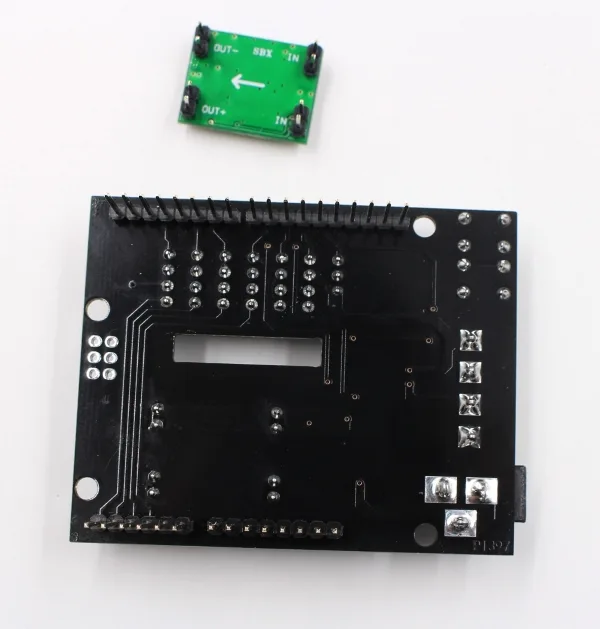
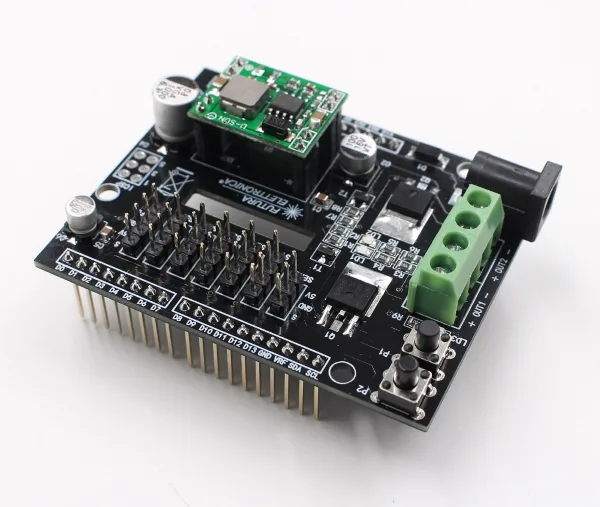
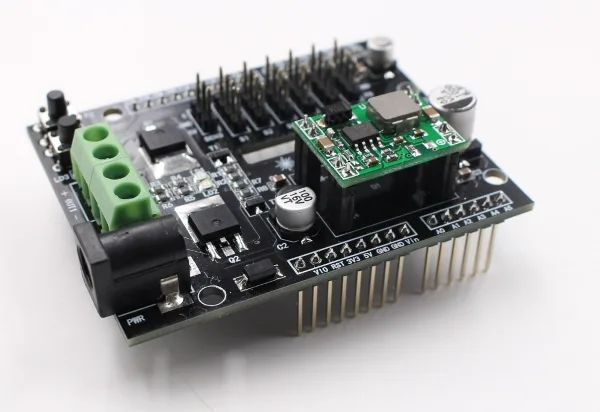
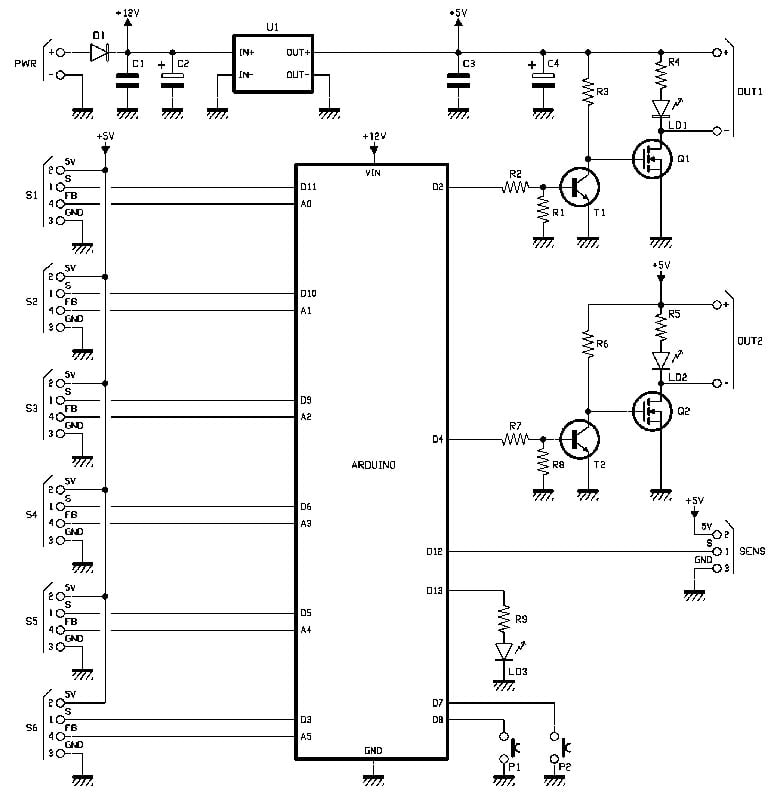
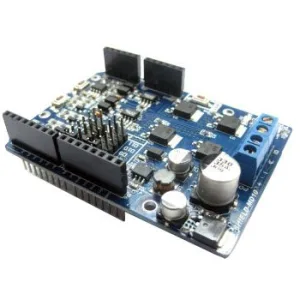
Shield for Arduino/Fishino UNO that allows controlling up to six traditional 3-pin RC servos (+5V / – / PWM) and with 4-pin feedback (+5V / – / PWM / Feedback). It also features a 5-volt 3 A power supply based on the WP1584 chip, two MOSFET power outputs with status LEDs, 1 digital input, and two buttons for future developments (Arduino I/O D7 and D8). The shield’s onboard power supply provides all the current that 13 kg/cm servos require to operate. The servo connectors consist of a 4-pole pin-strip, whose pinout reflects the standard adopted by servos with feedback.
The shield does not draw power from Arduino (indeed, none of the latter board’s power pins are connected), but from a separate onboard DC jack, labeled PWR in the schematic; the input power, passed through the reverse-polarity protection diode, is filtered and stabilized to 5 volts.
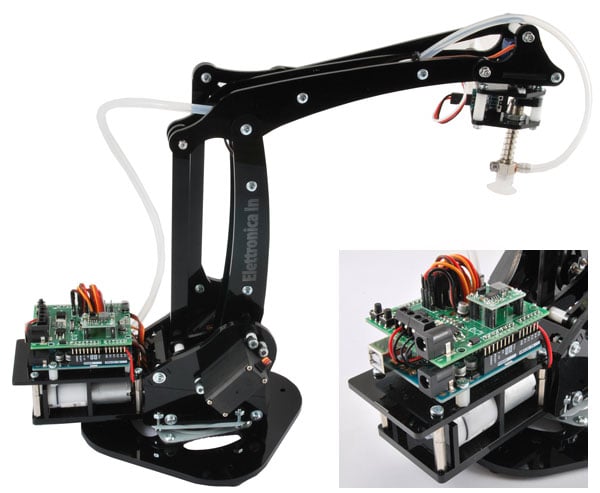
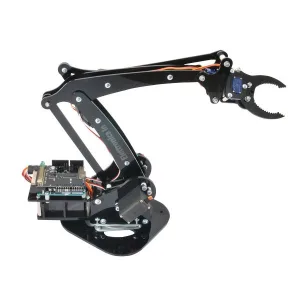
The shield with our Plexiglass Robotic Arm 7100-ROBOARM
Technical specifications
- Power output current (OUT1 and OUT2): 1 A
- Buttons for future developments (P1 and P2): 2
Electrical Schematic (click on the image to enlarge)
Sketch prepared ad-hoc with explanations on how to set its parameters in order to make the arm perform the desired movements.
The firmware includes a series of sections that describe the movement, intended as servo rotation and time taken to achieve it, one for each of the 6 servos that the shield can manage.
To create a sequence, simply customize these parameters; to that end, remember that you must make the movements up to the desired angle for each servo, record the angle, then connect Arduino to PC, edit the sketch parameters, then reload the sketch and run it in a loop.
Technical details
| External power supply | 12 VDC separate from Arduino |
|---|---|
| Internal regulation | 5 VDC – 3 A |
| Power outputs | 2 with indicator LEDs |
| Servo outputs (S1 to S6) | 6 |
| Digital inputs (SENS) | 1 |
You may also like…
-
 Arduino
 -
 Robots
Articulated plexiglass robotic arm with 4 degrees of freedom and rotating base
€72.95excl. VAT€89.00incl. VAT -
 Actuators
Related products
-
 Arduino
 -
 Control electronics
 -
 Arduino compatible
 -
 Displays
 -
 Arduino compatible
 -
 Development systems
 -
 Arduino
 -
Sale!
 Arduino compatible